

Introduction to the World of Financial Trading
In the modern digital era, the barrier to entry for financial markets has never been lower. However, with accessibility comes a complex array of choices. For many retail traders, the debate often boils down to two primary instruments: Binary Options and Forex Derivatives. While both allow traders to speculate on price movements in the global markets, they operate on fundamentally different mechanics, risk profiles, and reward structures.
Platforms like Deriv have revolutionized this space by offering both traditional forex trading, unique multipliers, and binary options (often called Digital Options or Fixed-Time Trades) under one roof. Understanding the nuances between these two is critical for any trader looking to build a sustainable portfolio. This guide provides an exhaustive comparison to help you determine which path aligns with your financial goals and risk tolerance.
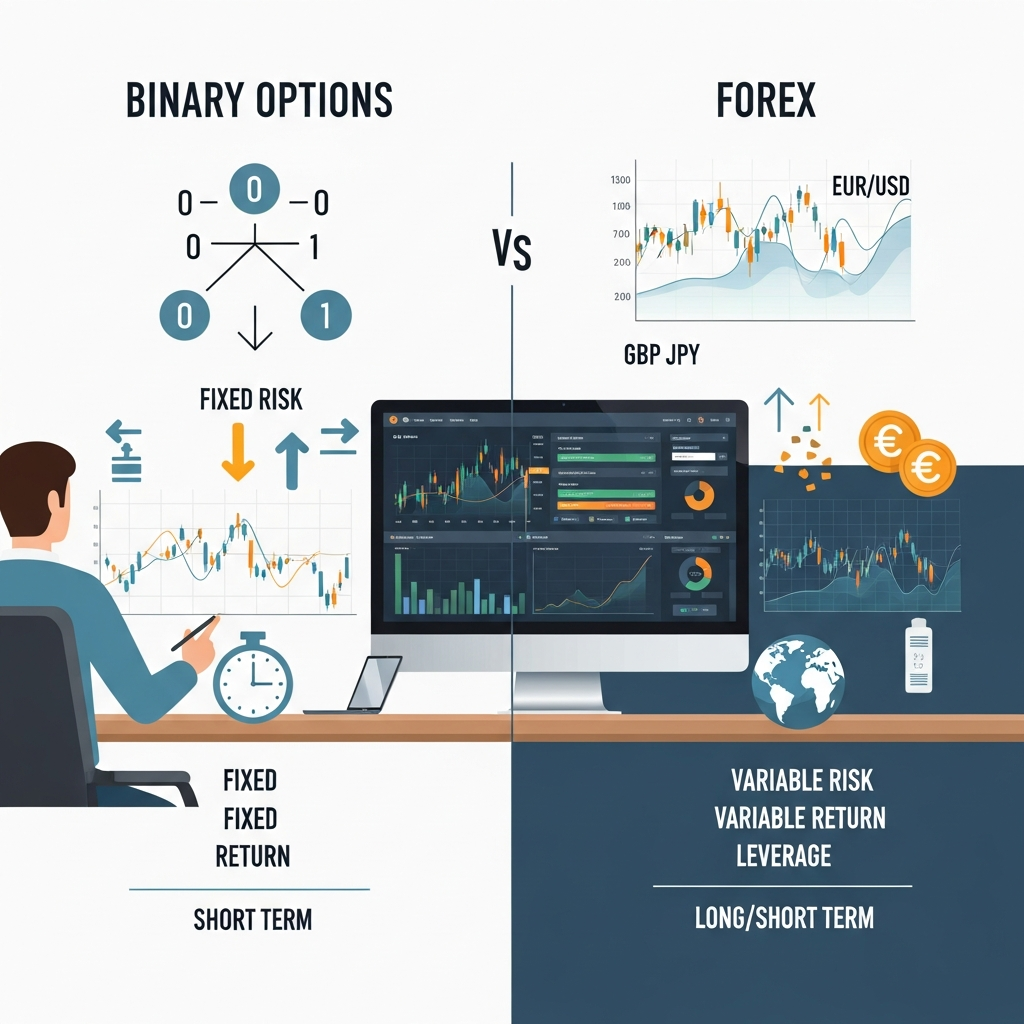
Table of Contents
- What are Binary Options?
- Understanding Forex Derivatives and CFDs
- The Deriv Ecosystem: Multipliers and Synthetic Indices
- Key Differences: Payouts, Expiry, and Control
- Risk Management Comparison
- Pros and Cons: Binary vs. Forex
- Which One Should You Choose?
- FAQ
- Conclusion
What are Binary Options?
Binary options are often described as the simplest way to trade the markets. The term “binary” refers to the two possible outcomes: you either win a fixed amount or lose your initial investment. There is no middle ground. When trading binary options, you are making a prediction on whether the price of an asset (such as EUR/USD or Gold) will be above or below a certain price at a specific expiration time.
How it Works
If you believe the price will rise, you place a “Call” (or Up) option. If you believe it will fall, you place a “Put” (or Down) option. You select your stake (e.g., $10) and an expiry time, which can range from 30 seconds to several days. If your prediction is correct by even a single pip at the moment of expiry, you receive a fixed payout—typically 70% to 95% of your stake. If you are wrong, you lose the $10 stake.
Understanding Forex Derivatives and CFDs
Forex trading, particularly via Derivatives or Contracts for Difference (CFDs), is the more traditional route. Unlike binary options, there is no fixed payout. Your profit or loss is determined by the distance the price moves in your favor or against you. This is measured in “pips.”
The Role of Leverage
In forex derivatives, traders use leverage to control large positions with a small amount of capital. For example, with 1:100 leverage, a $100 deposit allows you to control $10,000 worth of currency. While this magnifies potential profits, it equally magnifies potential losses, making risk management (like Stop Losses) non-negotiable.
The Deriv Ecosystem: Multipliers and Synthetic Indices
Deriv.com is unique because it bridges the gap between these two worlds. One of their standout products is Multipliers. Multipliers combine the limited risk of binary options with the profit potential of forex trading. When you trade with a multiplier, you set your stake, and if the market moves in your favor, your profit is multiplied. However, your loss is strictly limited to your initial stake, acting like an automatic stop loss.
Furthermore, Deriv offers Synthetic Indices. These are proprietary markets that mimic real-world market movements but are generated by cryptographically secure algorithms. They are available 24/7, providing a consistent environment for both binary and forex derivative strategies regardless of bank holidays or traditional market hours.
Key Differences: Payouts, Expiry, and Control
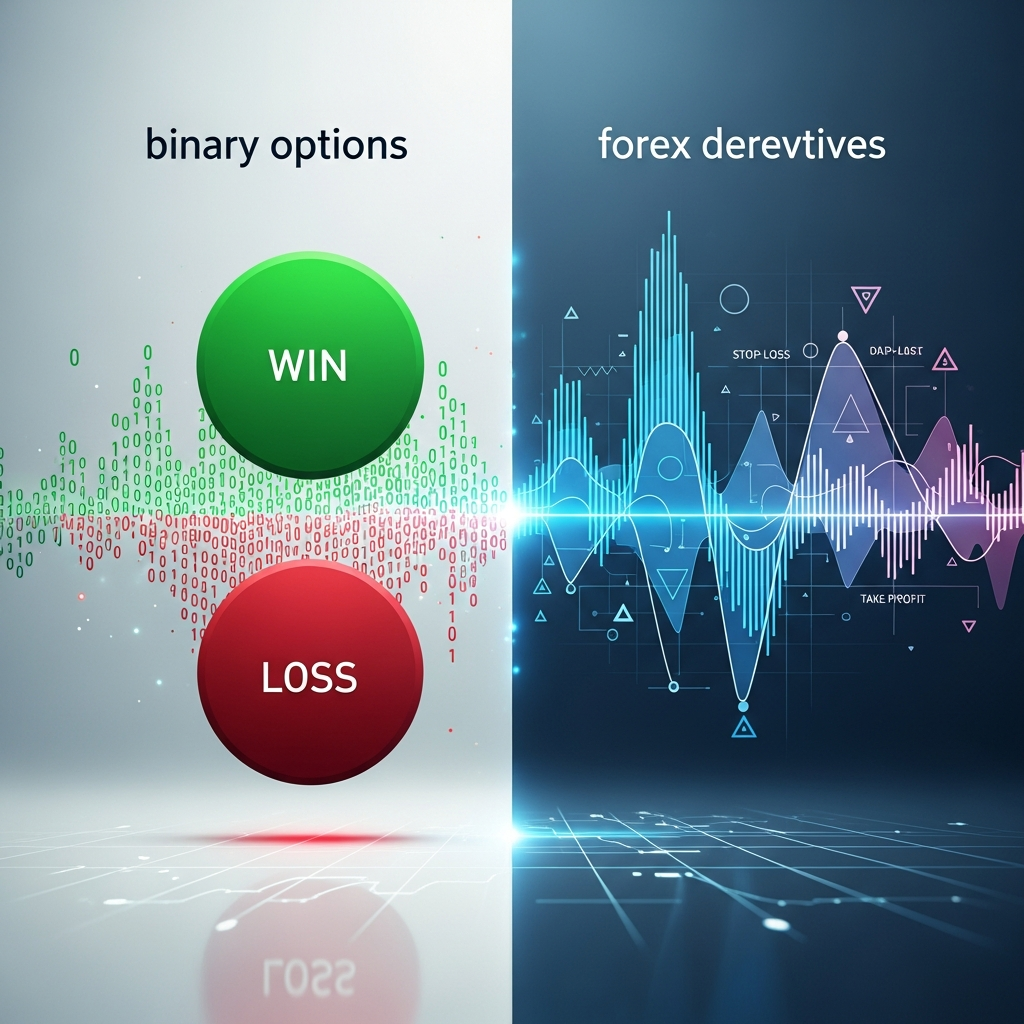
| Feature | Binary Options | Forex Derivatives (CFDs) |
|---|---|---|
| Profit Potential | Fixed (e.g., 85% of stake) | Variable (Unlimited) |
| Risk | Fixed (Total stake) | Variable (Can exceed stake without SL) |
| Expiry Time | Required (Fixed) | Optional (Open-ended) |
| Market Direction | Direction matters only | Direction and distance matter |
| Complexity | Low | High |
The Element of Time
In binary options, time is your enemy. You must not only be right about the direction but also right about when the price will be there. In forex derivatives, you can hold a trade for as long as you want (assuming you have the margin), allowing the market time to move in your favor even after a temporary dip.
Risk Management Comparison
Risk management is the cornerstone of professional trading. In Binary Options, risk management is inherent; you cannot lose more than you put into a single trade. This makes it attractive for beginners who struggle with setting stop losses.
In Forex Derivatives, risk management is manual. You must calculate your lot size, determine your entry and exit points, and set a Stop Loss. Without a disciplined approach, a single bad trade in a leveraged forex account can wipe out a significant portion of your balance. However, the ability to move a Stop Loss to “Break Even” or use “Trailing Stops” gives forex traders a level of flexibility that binary traders lack.
Pros and Cons: Binary vs. Forex
Binary Options Pros
- Simplicity: High/Low, Yes/No.
- Known Risk: You know exactly what you stand to lose before you click.
- Short Duration: Results in as little as 60 seconds.
Binary Options Cons
- Fixed Odds: The house often has a mathematical edge (payouts are usually <100%).
- No Flexibility: You cannot exit a trade early to secure partial profits in most setups.
Forex Deriv Pros
- High Reward: A single strong trend can yield 500% or more on a position.
- Technical Precision: Better suited for advanced chart analysis.
- Liquidity: The forex market is the most liquid in the world ($6+ trillion daily).
Forex Deriv Cons
- Complexity: Requires knowledge of pips, lots, leverage, and margin.
- Psychological Stress: Watching a floating loss can lead to impulsive decisions.
Which One Should You Choose?
The choice between binary options and forex derivatives depends on your personality and goals. If you prefer high-speed action and want to know your exact risk upfront, binary options on a platform like Deriv might be your starting point. It is particularly useful for trading volatile news events where you expect a quick reaction.
On the other hand, if you enjoy technical analysis, following long-term trends, and want the ability to manage a trade as it evolves, forex derivatives are the superior choice. Many professional traders eventually migrate to forex or use Deriv Multipliers because they offer a more sustainable mathematical edge over the long run.
Frequently Asked Questions (FAQ)
1. Is Binary Options trading legal?
The legality of binary options varies by country. In the EU and UK, they are heavily restricted for retail traders, while in other jurisdictions, they are perfectly legal when traded through regulated brokers like Deriv.
2. Can I trade both on the same platform?
Yes. Platforms like Deriv allow you to use a single balance to trade Binary Options (SmartTrader), Forex CFDs (MT5), and Multipliers (DTrader).
3. Which is more profitable for beginners?
Binary options are easier to understand initially, but many beginners find Forex CFDs with low leverage more forgiving because they don’t have a “ticking clock” forcing the trade to close.
4. What are Synthetic Indices?
Synthetic indices are unique to Deriv. They are simulated markets that are not affected by global news, making them ideal for traders who prefer pure technical analysis and 24/7 availability.
Conclusion
Neither Binary Options nor Forex Derivatives is inherently “better”—they are simply different tools in a trader’s toolkit. Binary options offer simplicity and defined risk, while forex derivatives offer flexibility and unlimited profit potential. By utilizing a broker like Deriv, you have the luxury of experimenting with both. The most successful traders are those who master their psychology, understand the math behind their chosen instrument, and never risk more than they can afford to lose. Whether you choose the fixed-time thrill of binary or the strategic depth of forex, consistency and education remain the keys to your success.