
Introduction to Pocket Option Signals
In the fast-paced world of binary options trading, timing is everything. For many traders, the difference between a profitable trade and a loss lies in the ability to interpret market data quickly. This is where Pocket Option signals come into play. These signals act as actionable alerts, notifying traders of potential price movements in assets like forex, stocks, and cryptocurrencies. Whether you are a novice looking for a starting point or a professional seeking to optimize your workflow, understanding how to harness these signals is a critical skill.
Pocket Option has solidified its reputation as a leading platform by integrating sophisticated signaling tools directly into its user interface. Unlike other brokers that require third-party subscriptions, Pocket Option offers a range of native features designed to provide traders with a competitive edge. This guide will explore the mechanics of these signals, how to access them, and the strategic frameworks needed to use them effectively.
Understanding Built-in Platform Signals
Pocket Option offers a dedicated ‘Signals’ section accessible via the side menu of the trading dashboard. These signals are generated by proprietary algorithms that monitor multiple technical indicators simultaneously. When specific market conditions are met—such as an asset reaching an oversold state on the RSI while hitting a support level—the platform generates a ‘Put’ or ‘Call’ signal.
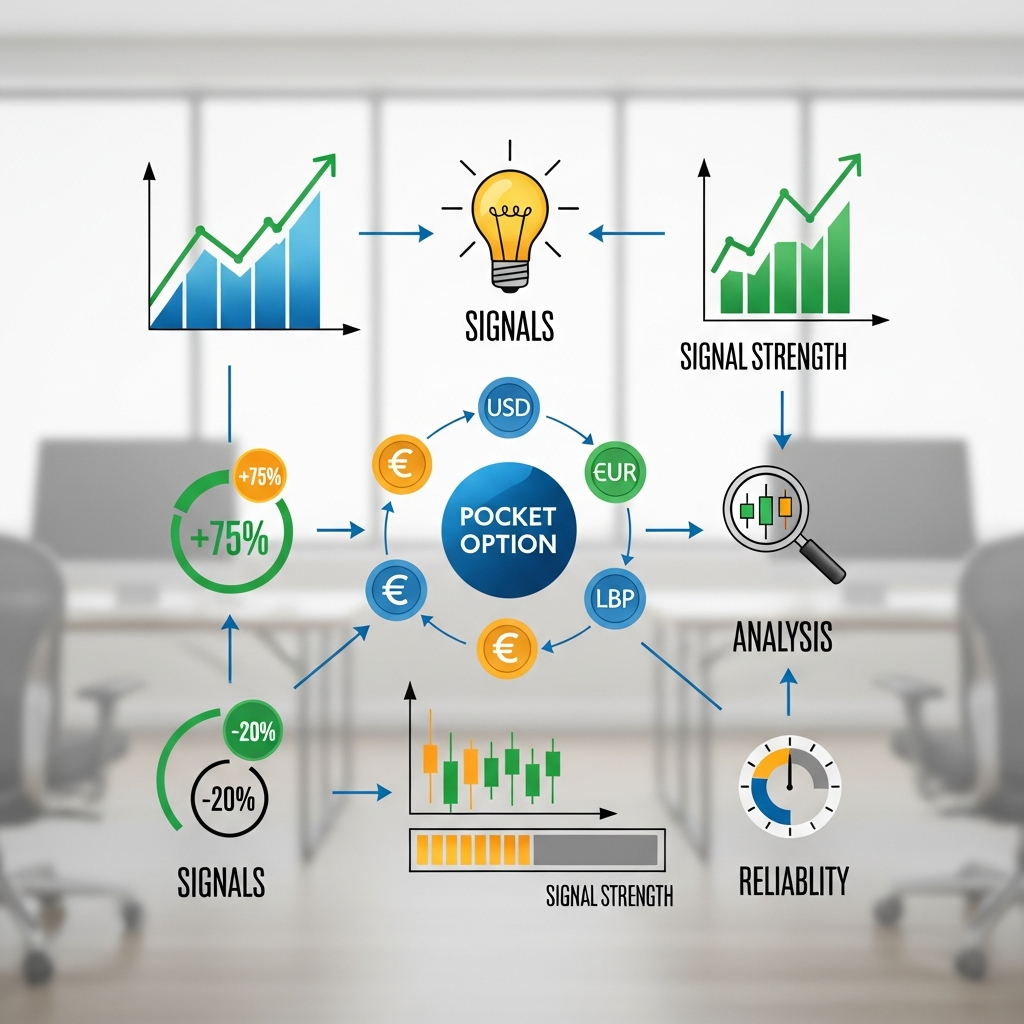
The built-in signals provide several key pieces of information: the asset pair, the suggested direction (Higher/Lower), the timeframe (from 1 minute to several hours), and the strength of the signal. The strength is often represented by a percentage or a star rating, indicating the algorithm’s confidence in the trade. For beginners, this simplifies the decision-making process significantly. Instead of staring at complex charts for hours, a trader can wait for a high-probability signal to appear and then conduct a quick manual check before entering the trade.
External Telegram and Bot Signals
Beyond the native tools, a massive ecosystem of external Pocket Option signals exists. The most popular medium for these is Telegram. Many professional trading communities and ‘signal providers’ run channels where they post real-time alerts. These are often more nuanced than automated platform signals because they are frequently curated by human analysts who account for fundamental news events—something most bots struggle to do.
However, the external signal market requires caution. While there are legitimate providers with verified track records, the industry is also filled with ‘scam’ bots that promise a 99% win rate. It is essential to remember that no signal is 100% accurate. When choosing an external signal source, look for transparency, historical data, and a community of active users. Some advanced traders also use Signal Bots that connect to the Pocket Option API, allowing for near-instant execution of trades based on specific triggers from TradingView alerts.
The Power of Copy Trading as a Signal
One of the most innovative ways to receive signals on Pocket Option is through their Social Trading or Copy Trading feature. In this model, the ‘signal’ is the real-time action of a professional trader. Instead of receiving a text alert, you see what the top-ranked traders are doing and can choose to replicate their trades automatically.
This method is highly effective because it allows you to filter ‘signals’ based on the performance history of a human being. You can see their total profit, win rate, and most-traded assets. By copying a trader with a consistent strategy, you are essentially following a living signal provider. It is a more passive approach, but it requires careful selection of whom to follow, as their losses will also be your losses.
Validating Signals with Technical Analysis
Never take a signal at face value. To maximize your success with Pocket Option signals, you must implement a validation layer. This means checking the signal against your own technical analysis. If a signal suggests a ‘Call’ (Buy), but the price is currently bumping against a massive psychological resistance level on a higher timeframe, it might be a false signal.

Popular tools for validation include:
- Relative Strength Index (RSI): Is the asset actually oversold?
- Moving Average Convergence Divergence (MACD): Is there a momentum crossover supporting the signal?
- Bollinger Bands: Is the price at the outer limits of its volatility?
- Volume: Is there enough market participation to sustain the move?
By combining a signal with at least one or two of these indicators, you significantly increase the probability of a winning trade. This process is known as ‘confluence.’ When the signal and the indicators align, you have a high-conviction trade setup.
Risk Management and Psychology
Even the best Pocket Option signals will fail during high-impact news events or unexpected market shifts. This is why risk management is non-negotiable. A common mistake among traders using signals is ‘over-leveraging’ because they feel the signal is a ‘sure thing.’ There are no sure things in financial markets.
A disciplined trader never risks more than 1% to 3% of their total account balance on a single signal. Furthermore, it is vital to manage your psychology. If you experience a ‘losing streak’ with a signal provider, the temptation to ‘revenge trade’ by doubling your investment is high. Stick to your plan. If the signals aren’t working in a volatile market, the best trade is often no trade at all.
Frequently Asked Questions
Can I use Pocket Option signals on the mobile app?
Yes, all signals, including built-in platform alerts and social trading features, are fully accessible via the Pocket Option mobile application for Android and iOS.
What is the best timeframe for Pocket Option signals?
While many traders prefer 1-minute or 5-minute signals for quick profits, these are also the most volatile. 15-minute and 30-minute signals generally offer higher reliability as they filter out market ‘noise’.
Do I need a high balance to use signals?
No, you can use signals even with the minimum deposit. However, always ensure your trade size is proportional to your balance to maintain proper risk management.
Conclusion
Mastering Pocket Option signals is about more than just clicking a button when an alert pops up. It is about integrating these tools into a broader, more robust trading strategy. By combining the convenience of built-in alerts with the human intelligence of copy trading and the rigor of technical validation, you can transform signals from simple notifications into a powerful engine for portfolio growth. Always prioritize risk management, stay skeptical of ‘guaranteed’ win rates, and continue to educate yourself on the underlying mechanics of the market.