
In the fast-paced world of financial derivatives, the role of a binary options signal provider has become increasingly pivotal for both novice and seasoned traders. Binary options trading, known for its “all-or-nothing” payout structure, requires precision, timing, and deep market analysis. However, not every trader has the hours required to study charts, monitor economic calendars, and analyze technical indicators. This is where a signal provider steps in, acting as the bridge between complex data and actionable trades.
What is a Binary Options Signal Provider?
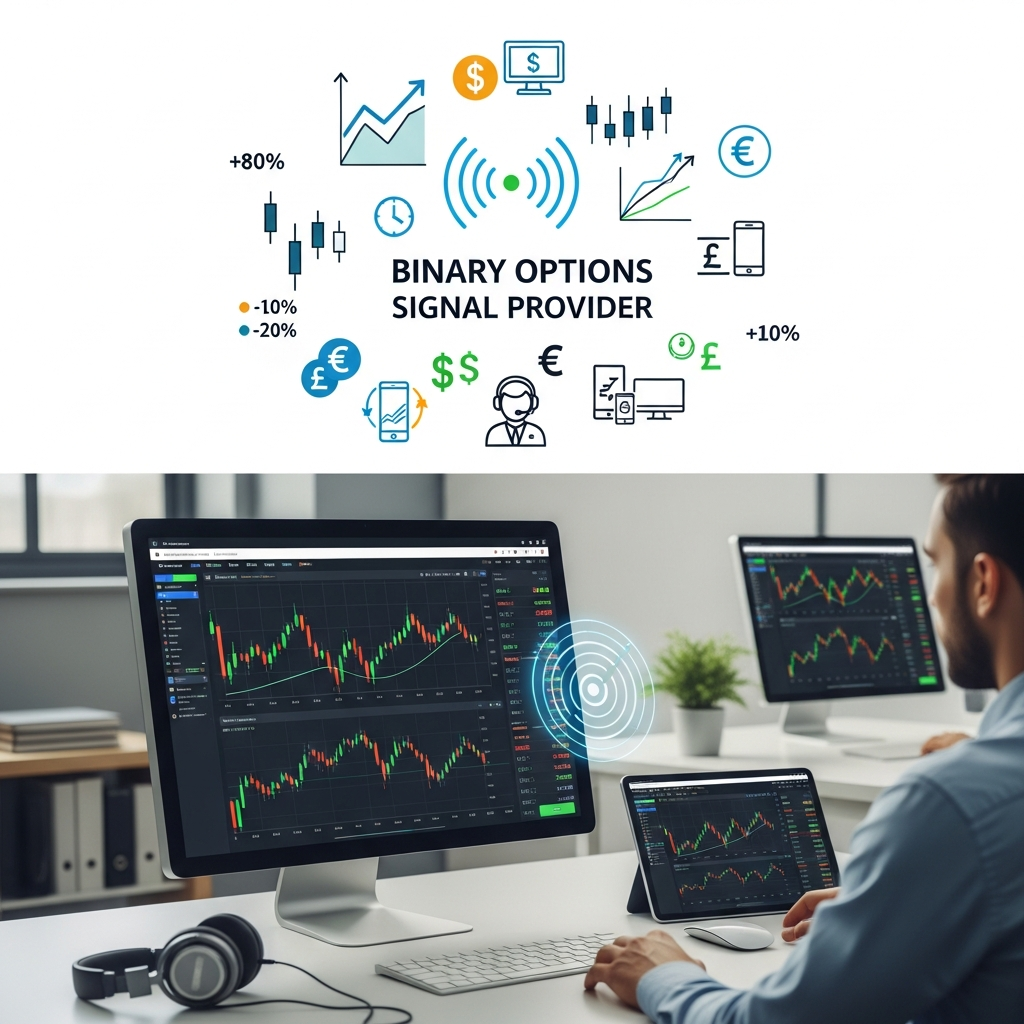
A binary options signal provider is a service or individual that analyzes market conditions to identify potential trading opportunities. Once a high-probability trade is spotted, the provider sends an alert—a “signal”—to their subscribers. These signals typically include the asset to trade (e.g., EUR/USD), the direction (Call/Put), the expiry time, and sometimes the entry price.
The goal is simple: to provide traders with a competitive edge by leveraging the expertise of professional analysts or the computational power of sophisticated algorithms. For many, these services are a form of “outsourced analysis,” allowing them to participate in the markets without needing a PhD in economics or years of experience in technical analysis.
How Binary Options Signals Work
The mechanism behind signals can be categorized into two primary methodologies: human analysis and algorithmic detection.
Manual Analysis by Expert Traders
Some providers rely on a team of professional traders who spend their day analyzing price action, fundamental news events, and market sentiment. These experts look for patterns such as support and resistance breakouts, Fibonacci retracements, or candlestick formations. The human element allows for the consideration of context—such as a sudden geopolitical event—that a machine might miss.
Automated Algorithmic Signals
On the other end of the spectrum are algorithmic signal providers. These utilize mathematical models and computer programs to scan hundreds of assets simultaneously. Algorithms use indicators like the Relative Strength Index (RSI), Moving Average Convergence Divergence (MACD), and Bollinger Bands to identify mathematical anomalies in price movement. These signals are often faster and devoid of human emotion.
Types of Signal Providers Available
Understanding the variety of providers is crucial for aligning their service with your trading style.
- Free Signal Providers: Often offered by brokers or community groups. While accessible, they may lack depth or serve as a marketing tool to encourage more frequent trading.
- Paid Subscription Services: Professional firms that charge a monthly fee. These usually provide higher quality signals, detailed performance logs, and educational resources.
- Copy Trading Platforms: A more modern approach where your account is linked to a master trader. When they execute a trade, the same trade is automatically opened in your account.
- Telegram and Social Channels: Many providers use Telegram for its speed and security, offering real-time push notifications directly to a trader’s smartphone.
Choosing the Best Provider for Your Needs
With thousands of services claiming 90% accuracy, how do you separate the wheat from the chaff? Finding the right binary options signal provider requires a systematic evaluation of several key factors.

Verification of Accuracy Claims
Avoid any provider that guarantees profits or claims a 100% win rate. Legitimate trading involves risk. Look for providers that offer a transparent, third-party verified track record (such as via Myfxbook or similar auditing services). A sustainable win rate in binary options typically falls between 60% and 75%.
Frequency and Delivery Time
A signal is useless if you receive it ten minutes after the entry window has closed. Evaluate how the signals are delivered. Are they via SMS, Email, or a dedicated Dashboard? If you are a part-time trader, you need a provider that sends signals during your specific trading window (e.g., the London or New York sessions).
Asset Coverage and Expiry Times
Does the provider focus on Forex, Commodities, or Indices? Furthermore, check if they specialize in short-term expiries (60 seconds to 5 minutes) or long-term expiries (hourly or end-of-day). Your choice should match your broker’s offerings and your personal risk tolerance.
Risk Management and Signal Integration
Even the best binary options signal provider cannot save a trader who lacks discipline. Signals should be treated as a tool, not a magic wand. Integrating these alerts into a broader risk management strategy is the hallmark of a professional trader.
The 1% Rule: Never risk more than 1% to 2% of your total account balance on a single signal. If a signal provider has a losing streak (which happens to everyone), this conservative approach ensures you have enough capital to stay in the game until the winning streak returns.
Confluence Trading: Instead of blindly following every signal, use them as a “second opinion.” If a signal provider suggests a “Call” on EUR/USD, check your own charts. If your own analysis also suggests an upward trend, you have “confluence,” which increases the probability of a successful trade.
Common Red Flags and Avoiding Scams
The binary options industry has unfortunately been a magnet for fraudulent actors. Protecting your capital starts with identifying red flags.
- Unrealistic Returns: Promises of turning $100 into $10,000 in a week are hallmarks of a scam.
- Managed Accounts: Be extremely wary of providers who ask for access to your funds or offer to “trade for you” in exchange for a percentage of the profits.
- Lack of Contact Information: Legitimate businesses have a physical presence, a professional website, and responsive customer support.
- Forced Broker Sign-ups: If a signal provider forces you to sign up with an unregulated or specific offshore broker to receive “free” signals, they are likely earning an affiliate commission on your losses.
Conclusion
A reliable binary options signal provider can be a transformative asset in your trading journey, offering insights that might take years to develop independently. However, the responsibility for success ultimately rests with the trader. By conducting due diligence, prioritizing transparency, and maintaining strict risk management, you can leverage signals to navigate the binary options market with greater confidence and precision.
Remember that no signal is a guarantee. Education, combined with high-quality alerts, is the most robust path to long-term profitability in the trading industry.
Frequently Asked Questions
Are free signals as good as paid ones?
Generally, no. Paid providers have a financial incentive to maintain high accuracy to keep subscribers, whereas free providers may lack the resources for deep analysis or may be funded by broker commissions.
Can I automate binary options signals?
Yes, some providers offer “Auto-traders” or “Bots” that link directly to your broker’s API. This allows the software to execute trades automatically based on the signals, though this carries higher risk due to potential technical glitches.
Which is the best timeframe for signals?
This depends on your style. 5-minute and 15-minute signals are popular because they offer a balance between trade frequency and market stability, whereas 60-second signals are highly volatile and prone to “market noise.”