

Binary Bot Tutorial for Beginners: Master Automated Trading in 2024
The world of financial trading has evolved significantly over the last decade. Gone are the days when traders had to sit glued to their screens for 12 hours a day, manually monitoring candlestick patterns and executing trades. Today, automation is the name of the game. If you have ever been curious about how to automate your binary options strategy, you are in the right place. This binary bot tutorial for beginners will guide you through the fundamentals of building, testing, and deploying your own automated trading script.
What is a Binary Bot?
In the simplest terms, a binary bot is a pre-programmed script or software that automatically executes trades on a binary options platform based on a set of predefined rules. These rules can include technical indicators (like RSI or Moving Averages), price action triggers, or specific time-of-day constraints.
The primary advantage of using a binary bot is the elimination of human emotion. Greed, fear, and revenge trading are the three biggest killers of a trader’s bankroll. A bot follows the logic you provide without hesitation, ensuring that your strategy is executed with 100% consistency.
Step 1: Choosing the Right Platform
Before you can start building, you need a platform that supports bot integration. The most popular choice for beginners and intermediates alike is Deriv (formerly Binary.com). They offer a specialized tool called DBot, which uses a visual “block-based” programming language. This means you don’t need to know how to write Python or C++; you simply drag and drop logical blocks together, much like building with LEGO.
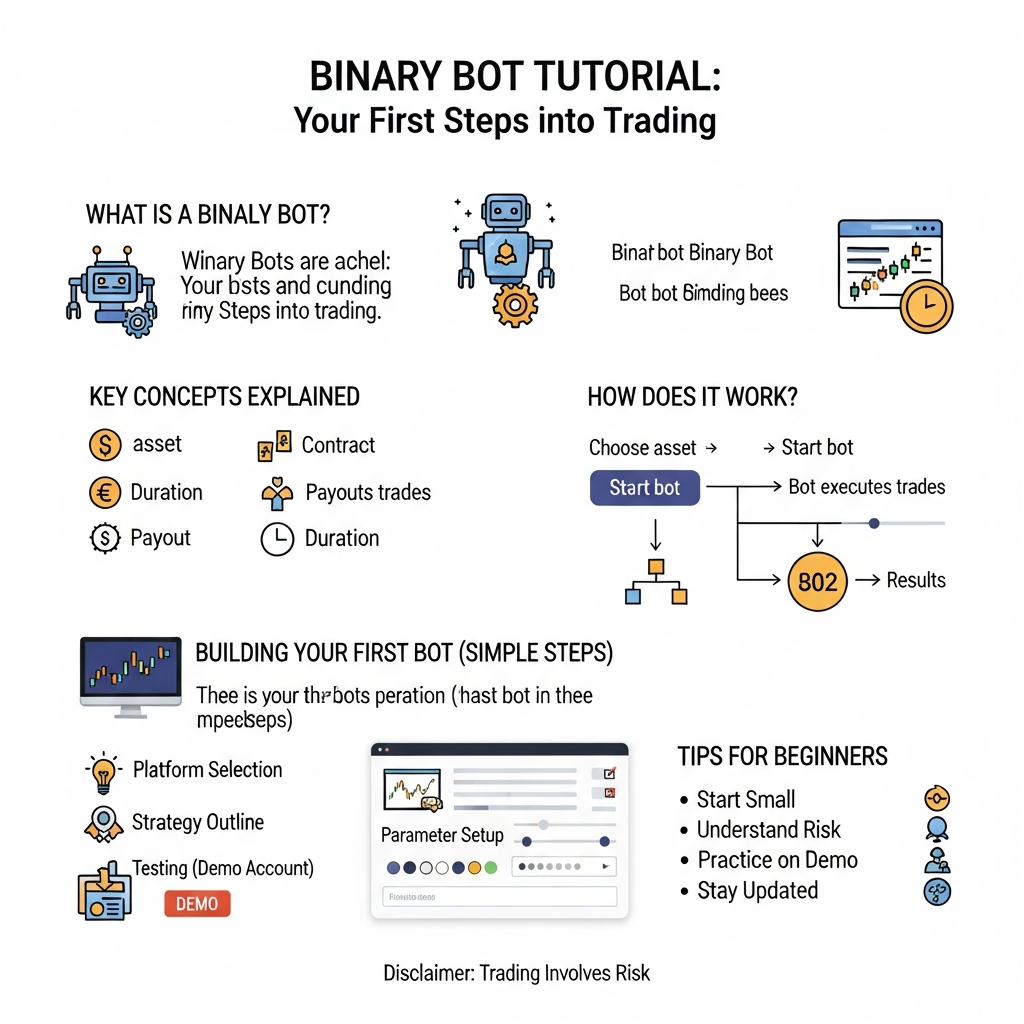
Understanding the 4 Essential Blocks
When you first open a tool like DBot, you will see four distinct areas (or blocks) that form the skeleton of any binary bot. Understanding these is the core of any binary bot tutorial for beginners.
1. Trade Parameters (Block 1)
This is where you define the “Where” and “What” of your bot. You select the market (e.g., Volatility 100 Index, Forex pairs), the type of trade (Rise/Fall, Over/Under), and your stake. Crucially, this is also where you set your contract duration—whether it’s 5 ticks, 1 minute, or 1 hour.
2. Purchase Logic (Block 2)
This is the “Brain” of the bot. Here, you define the conditions under which the bot should buy a contract. For example: “If the current price is higher than the average of the last 10 candles, then buy a Rise contract.” Without this block, your bot won’t know when to enter the market.
3. Restart/Trade Results (Block 4)
This block tells the bot what to do after a trade is completed. Should it stop? Should it trade again immediately? This is where you implement money management strategies like Martingale (doubling the stake after a loss) or flat betting.
4. Analysis (Block 3)
This optional block allows you to perform extra calculations while the trade is active. Most beginners leave this at its default setting until they advance to more complex strategies.
Building Your First Simple Strategy: The RSI Cross
Let’s walk through a basic strategy often used in binary bot tutorials for beginners. The Relative Strength Index (RSI) is a momentum oscillator. If the RSI is above 70, the market is “overbought.” If it’s below 30, it is “oversold.”
- The Goal: Buy a ‘Fall’ contract when RSI crosses above 70, and buy a ‘Rise’ contract when RSI crosses below 30.
- Implementation: In Block 2 (Purchase Logic), you would drag an “If” statement. Inside that, you place the RSI indicator block set to 14 periods. You then tell the bot: “If RSI < 30, Purchase Rise."

Risk Management: The Most Important Lesson
No bot is 100% profitable. The difference between a successful bot trader and a broke one is risk management. Here are three rules every beginner must follow:
1. The 5% Rule
Never allow your bot to risk more than 5% of your total account balance in a single session. If you have $100, set your “Stop Loss” in Block 4 to $5. This ensures that even a bad run won’t wipe you out.
2. The Martingale Trap
Many “free binary bots” found online use a Martingale strategy. This means if you lose $1, the bot bets $2. If it loses that, it bets $4. While this can recover losses quickly, a string of 7 or 8 losses will completely drain your account. As a beginner, start with “Flat Stakes” where the bet amount never changes.
3. Take Profit Limits
Automated bots can run 24/7, but the market conditions they are designed for (like a ranging market) won’t last that long. Set a “Take Profit” limit. Once the bot reaches a $10 profit, tell it to stop automatically.
Testing Your Bot: Virtual vs. Real
One of the biggest mistakes beginners make is running a new bot on a real money account immediately. Most reputable platforms provide a “Virtual” or “Demo” account with $10,000 in play money.
You should run your bot on a demo account for at least 100 trades. This gives you a statistically significant sample size to see if the logic actually works. If the bot is profitable over 100 trades in different market conditions, only then should you consider switching to a live account with the minimum possible stake.
Advanced Tips for Success
As you progress beyond this binary bot tutorial for beginners, consider these advanced optimizations:
- Market Sentiment: Check a news calendar. Even the best bot can be ruined by a high-impact news event like the Non-Farm Payroll (NFP) report.
- Time Blocks: Certain bots work better during the London session, while others thrive during the New York session. Use the “Time” block to restrict when your bot is active.
- XML Backups: Always save your bot logic as an XML file on your computer. If the browser crashes or you accidentally delete a block, you can restore your work in seconds.
Common Pitfalls to Avoid
Many beginners fall into the “Holy Grail” trap—the belief that there is a perfect bot that never loses. It doesn’t exist. Be wary of anyone selling a “100% win rate” binary bot. These are almost always scams. Instead, focus on building a bot with a 60-65% win rate and solid money management.
Another common mistake is over-optimizing. If you add too many indicators to your bot (e.g., RSI + MACD + Bollinger Bands + Stochastic), the bot might never find a trade because the conditions are too strict. This is called “Analysis Paralysis” for bots. Keep your logic simple and clean.
Conclusion
Automating your trading through a binary bot is an exciting journey that combines financial logic with basic programming. By following this tutorial, you have learned that a bot is only as good as the logic you give it. Focus on the four core blocks, prioritize risk management over high returns, and always test extensively in a demo environment.
The beauty of the binary bot world is that the learning never stops. As you get comfortable with the basics, you can start exploring custom variables, tick-counting strategies, and complex mathematical filters. Start small, be patient, and let the code do the heavy lifting for you.