
In the fast-paced world of financial derivatives, binary options stand out for their simplicity and high-reward potential. However, the ‘all-or-nothing’ nature of these trades means that precision is paramount. To navigate this volatility, professional traders rely on the best binary trading indicators to filter out market noise and identify high-probability entry points. Trading without technical indicators is akin to sailing a ship in a storm without a compass; you might get lucky, but the odds are heavily stacked against you.
Successful binary options trading is not about predicting the future with a crystal ball. Instead, it is about calculating the statistical likelihood of a price movement within a specific timeframe. Whether you are trading 60-second contracts or hourly expiries, the right set of tools can transform a speculative gamble into a disciplined investment strategy.
Understanding Binary Trading Indicators
Binary trading indicators are mathematical calculations based on the price, volume, or open interest of a security. In binary options, where the primary goal is to predict if the price will be above or below a certain point at a specific time, these indicators help clarify the market’s momentum, volatility, and trend direction.
Technical indicators are generally categorized into four types: trend, momentum, volatility, and volume. For binary traders, trend and momentum indicators are often the most critical because they signal the strength of a price movement. Since binary options have fixed expiration times, understanding how fast and how far a price is likely to move is the cornerstone of a winning strategy.
Top 7 Best Binary Trading Indicators
While hundreds of indicators exist, only a few have stood the test of time in the binary options market. Below are the most effective tools used by high-volume traders to secure consistent returns.
1. Relative Strength Index (RSI)
The RSI is a momentum oscillator that measures the speed and change of price movements. It oscillates between 0 and 100. Traditionally, an RSI value above 70 indicates that an asset is overbought (likely to see a price drop), while a value below 30 suggests it is oversold (likely to see a price increase).
In binary trading, the RSI is incredibly useful for ‘reversal’ strategies. If the RSI hits 75 and you see a bearish candlestick pattern, it is a strong signal to place a ‘Put’ option. Conversely, an RSI dipping to 25 combined with a bullish hammer candle is a prime ‘Call’ option signal.
2. Bollinger Bands
Bollinger Bands consist of a middle band (a simple moving average) and two outer bands that represent standard deviations. These bands expand and contract based on market volatility. When the price touches the upper band, the asset is often considered overbought. When it touches the lower band, it is considered oversold.
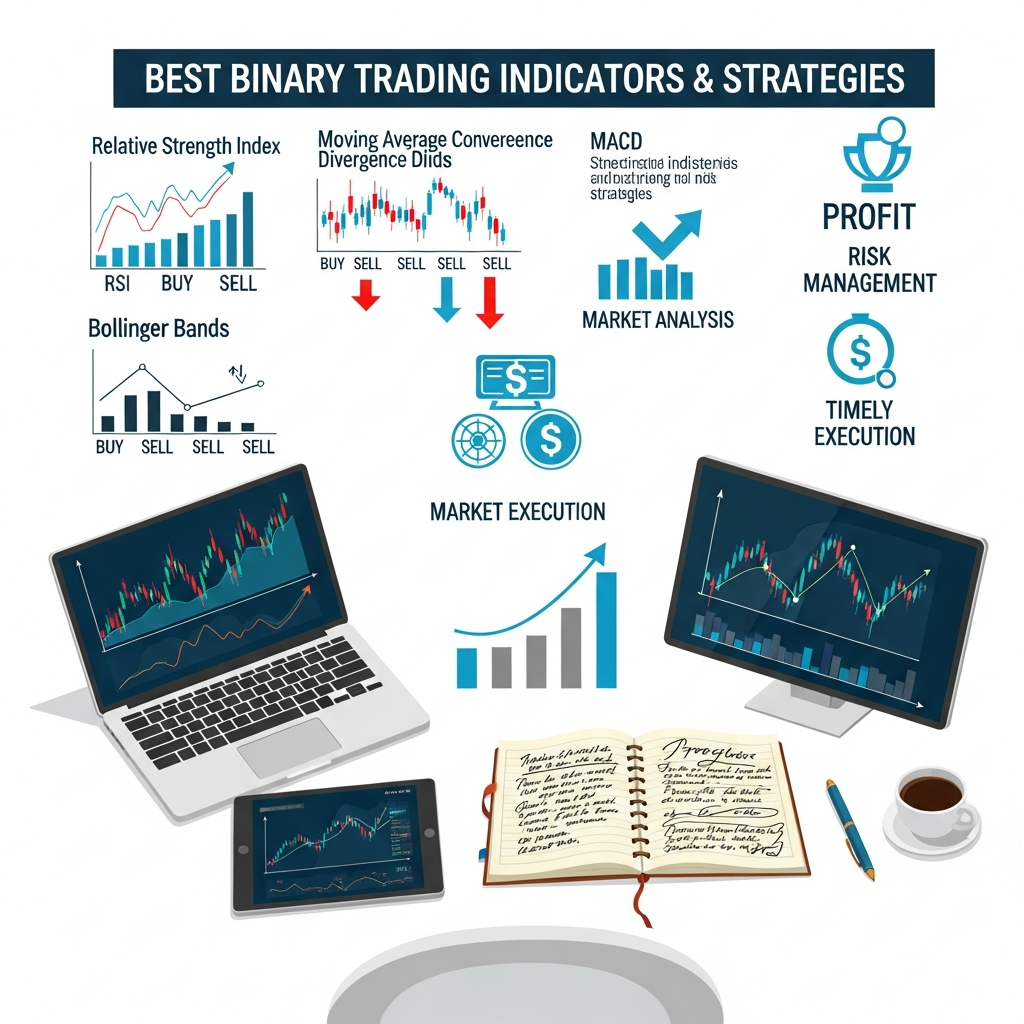
The ‘Bollinger Squeeze’ is a favorite strategy for binary traders. When the bands tighten, it indicates low volatility and suggests a massive price breakout is imminent. Traders wait for the price to break either the upper or lower band to enter a trade in that direction.
3. Moving Average Convergence Divergence (MACD)
The MACD is a trend-following momentum indicator that shows the relationship between two moving averages of an asset’s price. It consists of the MACD line, the signal line, and a histogram. A ‘crossover’ is the most common signal: when the MACD line crosses above the signal line, it’s a bullish signal. When it crosses below, it’s bearish.
For binary options, the MACD histogram is particularly useful. If the bars are growing larger above the zero line, the upward momentum is increasing, making a ‘Call’ option more favorable for short-to-medium expiries.
4. Stochastic Oscillator
Similar to the RSI, the Stochastic Oscillator helps identify overbought and oversold levels but focuses on the closing price relative to the price range over a specific period. It is often faster than the RSI, making it one of the best binary trading indicators for 60-second or 5-minute trades.
Traders look for the %K line to cross the %D line. When this crossover happens in the oversold zone (below 20), it provides a powerful buy signal for binary traders looking for a quick bounce back.
5. Simple and Exponential Moving Averages (SMA/EMA)
Moving averages smooth out price data to create a single flowing line, making it easier to identify the trend direction. The Exponential Moving Average (EMA) is particularly popular in binary trading because it places more weight on recent price data, reacting faster to market shifts than the SMA.
A common strategy is the ‘Moving Average Crossover.’ When a short-term EMA (e.g., 9-period) crosses a long-term EMA (e.g., 21-period), it signals a shift in trend. This is a reliable way to pick the direction for longer-duration binary options.
6. Average True Range (ATR)
The ATR does not tell you the direction of the trend, but it tells you how much the price is moving. High ATR values mean high volatility. This is vital for binary options because if the ATR is too low, the price might not move enough to surpass your strike price before expiration, leading to a loss even if you picked the right direction.
7. Ichimoku Cloud
The Ichimoku Cloud is a comprehensive indicator that defines support and resistance, identifies trend direction, and measures momentum. While it looks complex, binary traders primarily focus on the ‘Cloud’ (Kumo). If the price is above the cloud, the trend is bullish. If it is below, the trend is bearish. This provides a quick visual confirmation before placing a trade.
How to Combine Indicators for Better Results
Using a single indicator often leads to ‘false signals.’ The secret of professional binary traders is the use of ‘confluence’—the point where multiple indicators agree on a signal. For example, you might look for a situation where the price touches a lower Bollinger Band (oversold) AND the RSI is below 30 (oversold) AND a bullish engulfing candle appears.

A popular combination is the RSI + Bollinger Bands strategy. This duo is exceptional for mean reversion trades. Another effective pair is MACD + Moving Averages, which helps traders stay on the right side of a strong trending market. By combining a volatility tool with a momentum tool, you cover two different dimensions of market behavior, significantly increasing your win rate.
Common Mistakes to Avoid
Even with the best binary trading indicators, many traders fail due to avoidable errors. Here are the most common pitfalls:
- Over-complicating Charts: Adding 5 or 6 indicators creates clutter and conflicting signals. Stick to 2 or 3 that you understand deeply.
- Ignoring Economic News: Technical indicators cannot account for sudden geopolitical events or central bank announcements. Always check an economic calendar before trading.
- Chasing Losses: Indicators are probabilistic, not prophetic. There will be losing trades. The key is to manage your bankroll and not double down when an indicator signal fails.
- Incorrect Expiry Times: Using a 1-hour trend indicator to place a 60-second trade is a recipe for disaster. Ensure your indicator settings match your trade duration.
Frequently Asked Questions
Can I use these indicators on mobile trading apps?
Most modern binary options platforms and mobile apps offer built-in tools for RSI, MACD, and Bollinger Bands. While mobile screens are smaller, the mathematical calculations remain the same, allowing you to trade on the go.
Which timeframe is best for binary indicators?
For high-frequency binary trading, the 1-minute and 5-minute timeframes are standard. If you prefer a more stable environment with less noise, the 15-minute and 1-hour timeframes are excellent for identifying stronger trends with the best binary trading indicators.
Are indicators enough to guarantee a profit?
No. Indicators are tools to improve your odds. Success in binary trading also requires a solid understanding of price action, disciplined risk management (never risking more than 1-2% of your balance per trade), and emotional control.
Conclusion: Mastering the best binary trading indicators is a journey of continuous learning. By starting with foundational tools like the RSI and Bollinger Bands, and learning how they interact with price action, you can build a robust trading system. Remember, the goal is not to find a perfect indicator, but to find a combination that provides a consistent edge over the market.