

Binary options copy trading has emerged as a revolutionary force in the digital finance landscape. Historically, trading the financial markets required years of study, a deep understanding of technical indicators, and the psychological fortitude to manage high-stakes decisions. However, the rise of social trading and automation has bridged the gap between professional traders and novices. In this comprehensive guide, we explore how binary options copy trading works, why it is gaining massive traction, and how you can leverage it to potentially grow your portfolio.
What is Binary Options Copy Trading?
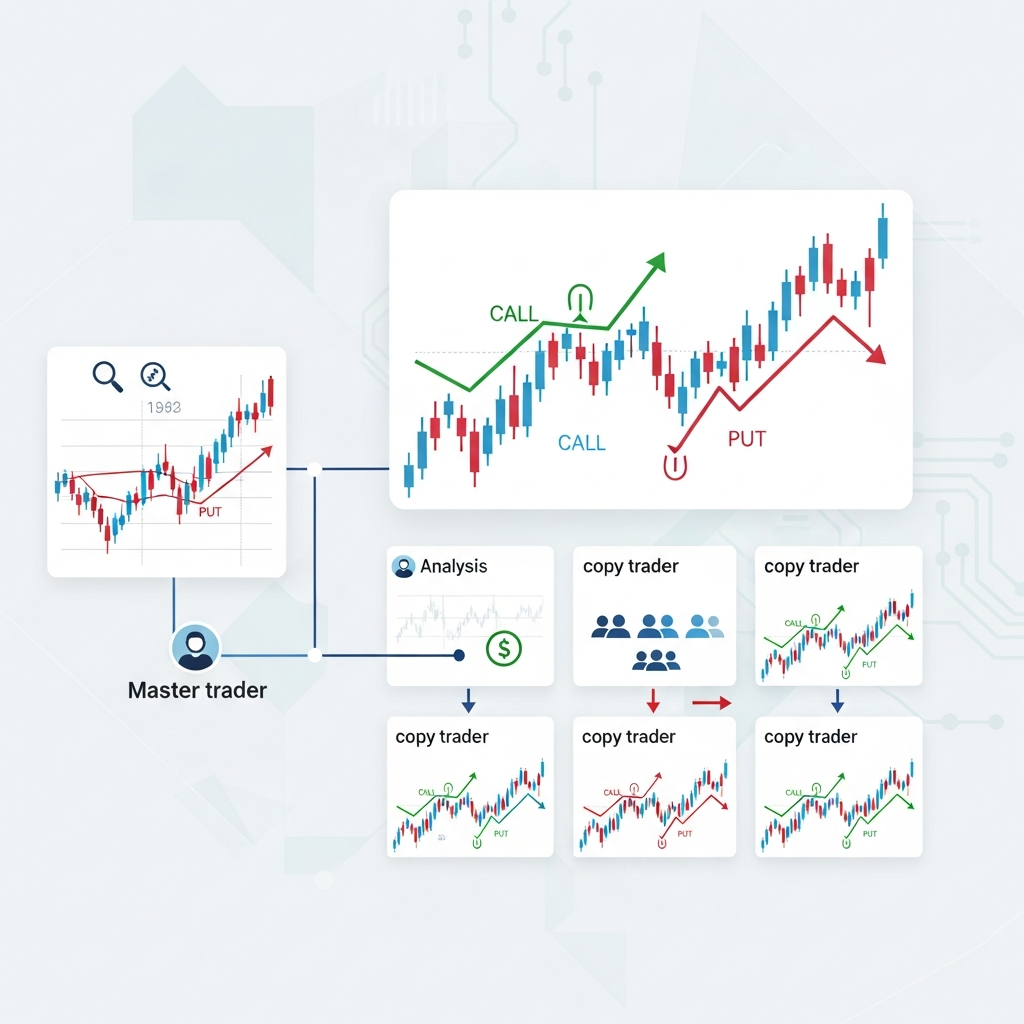
At its core, binary options copy trading is a form of social trading that allows individuals to automatically replicate the trades of experienced investors. In the binary options market, where trades are based on a simple ‘yes or no’ proposition regarding price movement over a specific timeframe, speed and accuracy are paramount. Copy trading systems use software to link your trading account with that of a ‘Master’ or ‘Signal Provider.’ When the Master opens a position, the same position is instantly opened in your account.
This democratization of trading means that you no longer need to spend eight hours a day staring at candlestick charts. Instead, you leverage the expertise of someone who does. It is particularly popular in the binary industry because of the high frequency of trades and the short expiration times, which can be difficult for human beginners to manage manually.
The Mechanics of Copy Trading: From Signal to Execution
The technical architecture behind copy trading is a marvel of modern FinTech. It involves three primary entities: the Signal Provider (the professional), the Subscriber (you), and the Platform (the broker or third-party software). When a Signal Provider identifies an opportunity—for example, a Call option on EUR/USD with a 5-minute expiry—they execute the trade. The platform’s API (Application Programming Interface) detects this action and broadcasts it to all connected follower accounts.
Depending on your settings, the trade is executed in your account using a proportional investment. For instance, if the Master trades 5% of their balance and you have set your account to follow their risk ratio, the software will automatically allocate 5% of your available balance to that same trade. This happens in milliseconds, minimizing ‘slippage’ (the difference in price between the provider’s entry and yours).
Choosing the Right Binary Options Platform
Not all brokers offer native copy trading features. When selecting a platform, technical reliability is the most important factor. You need a broker that offers low latency execution. In binary options, even a one-second delay can be the difference between a ‘In the Money’ (ITM) and ‘Out of the Money’ (OTM) result.
Key Features to Look For:
- Transparency: The platform should provide a full history of a trader’s performance, including their win rate, total profit, and maximum drawdown.
- Customization: Can you set a maximum daily loss? Can you choose the investment amount per trade? A good platform gives you granular control.
- Asset Variety: Ensure the platform supports copy trading across various assets like currencies, commodities, and indices.
- Regulation: While the binary industry is known for its offshore brokers, look for platforms with established reputations and positive user feedback to avoid withdrawal issues.
How to Select the Best Signal Providers
Selecting who to follow is the most critical decision in your copy trading journey. Many beginners make the mistake of simply choosing the trader with the highest ‘All-Time Profit.’ This can be a trap, as that profit might have been generated through reckless ‘Martingale’ strategies that are prone to catastrophic failure.
Metrics That Matter:
- Win Rate Consistency: Look for a win rate between 60% and 75%. Anything higher than 85% consistently is often a red flag for manipulated data or high-risk ‘all-in’ strategies.
- Trading Frequency: Some traders take 50 trades a day, while others take 2. Ensure their style matches your account balance and risk tolerance.
- Maximum Drawdown: This indicates the largest peak-to-trough decline in the trader’s account. A low drawdown suggests a trader who prioritizes capital preservation.
- Account Age: A trader who has been profitable for 12 months is far more reliable than one who has had a single ‘lucky’ month.
Advanced Risk Management Strategies
Copy trading is not ‘set and forget.’ To survive in the binary options market, you must implement strict risk management protocols. Even the best traders go through losing streaks. If you are following a trader with a 70% win rate, math dictates that you will eventually hit a string of 5 or 10 losses in a row.
The 2% Rule: Never allow the copied trades to exceed 2% of your total balance on a single position. If you have $1,000, your trade size should be $20. This allows you to weather the inevitable storms of market volatility.
Diversification: Don’t put all your eggs in one basket. Divide your capital among three different traders who use different strategies. For example, follow one ‘Trend Follower,’ one ‘Reversal Trader,’ and one ‘Scalper.’ This creates a balanced portfolio where one trader’s loss might be offset by another’s gain.
Pros and Cons of Automated Binary Trading
Understanding the dual nature of this tool is vital. It offers immense power, but it comes with specific vulnerabilities.
The Advantages:
- Passive Income Potential: It allows you to participate in the markets while you work, sleep, or travel.
- Educational Value: By observing the trades of professionals, you can learn about entry points, asset selection, and timing.
- Emotional Discipline: It removes human emotion—the number one killer of trading accounts—from the execution process.
The Disadvantages:
- Systemic Risk: If the platform goes down or the API disconnects, your trades may not close properly.
- Over-reliance: Relying solely on others prevents you from developing your own market intuition.
- Scams: The binary industry is rife with ‘fake’ gurus who manipulate their statistics to attract followers.

Technical Setup and Execution
To get started, you generally follow a three-step process. First, sign up for a broker that supports social trading. Second, fund your account with a manageable amount of ‘risk capital’—money you can afford to lose. Third, navigate to the ‘Social Trading’ or ‘Copy Trading’ section and use the filters to find traders that meet your criteria.
Once you click ‘Copy,’ you will be prompted to set your parameters. We recommend starting with a ‘Fixed Amount’ per trade rather than a ‘Percentage of Balance’ until you are comfortable with the trader’s performance. Always monitor the account daily for the first week to ensure the execution is seamless and there are no technical errors.
Conclusion: The Future of Binary Trading
Binary options copy trading represents the next evolution of retail investment. It levels the playing field, allowing everyday individuals to harness the skills of professional market analysts. However, it is not a magic wand for wealth. Success requires a strategic approach to selecting providers, a disciplined risk management framework, and constant vigilance.
By treating copy trading as a business rather than a gamble, and by diversifying your ‘copy portfolio,’ you can navigate the volatile waters of the binary options market with much greater confidence and potential for long-term sustainability.
Frequently Asked Questions
What is the best time to copy trade?
The best time is usually during the London and New York sessions when market liquidity is highest and trends are more predictable.
Can I stop copying a trader at any time?
Yes, most platforms allow you to disconnect or pause copying instantly with a single click. Any open trades will usually be managed according to your preference (either closed immediately or left to expire).
Do I have to pay the traders I follow?
This depends on the platform. Some brokers offer it for free to attract users, while others allow traders to charge a small percentage of the profits they generate for you (Performance Fee).