


Introduction to Automated Success with Deriv XML Bots
In the fast-paced world of digital trading, automation has moved from a luxury to a necessity for many professional traders. Deriv XML bot strategies represent the pinnacle of accessible algorithmic trading. By utilizing the DBot platform, traders can create, download, and share complex trading logic encapsulated in XML files. These files act as the ‘brain’ of your trading operation, executing trades with millisecond precision that no human could ever match.
Whether you are looking to trade Volatility Indices, Forex, or Commodities, understanding how to structure and optimize your XML bot is the difference between a blowing an account and achieving steady growth. This guide dives deep into the technical and strategic aspects of XML bot development on Deriv.
Understanding the XML Architecture in DBot
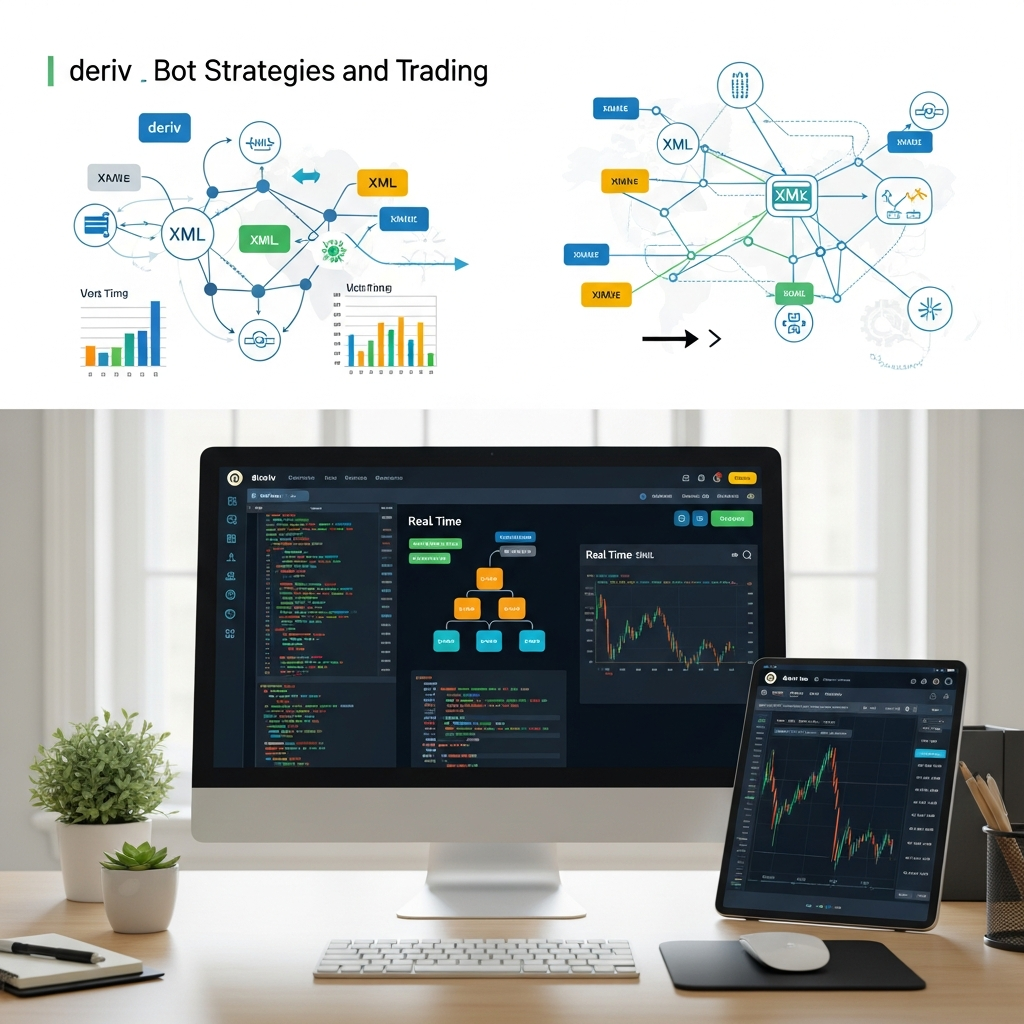
Deriv’s DBot platform uses a visual programming language known as Blockly. When you ‘save’ a bot you have built using these visual blocks, the platform converts that logic into an XML (Extensible Markup Language) file. This file contains every instruction: from the asset you are trading to the specific candle pattern that triggers a ‘Call’ or ‘Put’ option.
The beauty of the XML format is its portability. You can share your strategy with other traders or download premium bots from developers and upload them instantly. However, a deep understanding of the four main blocks in a Deriv XML bot is crucial:
- Block 1: Trade Parameters: This defines the market, contract type (Rise/Fall, Over/Under), and stake amount.
- Block 2: Purchase Conditions: This is the logic center. It dictates the ‘If/Then’ scenarios based on indicators.
- Block 3: Restart Trading: This block tells the bot what to do after a trade finishes (e.g., wait 5 minutes, increase stake).
- Block 4: Sell Conditions: Used primarily for contracts that allow early exit.
Essential Components of a Winning Strategy
A successful Deriv XML bot strategy is more than just a signal. It requires a holistic approach to the market. Most high-performing bots share three core components: Signal Accuracy, Execution Speed, and Money Management.
Signal accuracy is often derived from technical indicators like the Relative Strength Index (RSI), Bollinger Bands, or Moving Averages. The XML bot monitors these values in real-time, executing a trade the very second the criteria are met. This removes the ‘human lag’ and the emotional hesitation that often leads to missed opportunities.
Top Beginner-Friendly XML Strategies
1. The RSI Mean Reversion Strategy
One of the most reliable strategies for beginners involves the RSI indicator. The logic is simple: if the RSI on a Volatility 100 (1S) Index drops below 30, the market is oversold, and the bot triggers a ‘Rise’ trade. Conversely, if it rises above 70, it triggers a ‘Fall’ trade. In an XML bot, this is handled through a simple ‘If’ block comparing the ‘RSI Value’ variable against a fixed integer.
2. The Even/Odd Digit Strategy
In the world of synthetic indices, digit-based strategies are incredibly popular. An XML bot can be programmed to analyze the last digit of the previous five ticks. If the last three digits were ‘Even’, the bot might predict the next will be ‘Odd’. While this leans more toward probability than technical analysis, it remains a staple for many XML bot users due to its high frequency of trades.
Advanced Logic and Technical Indicators
For the seasoned trader, basic RSI triggers aren’t enough. Advanced Deriv XML bot strategies involve ‘Nested Logic’. This means the bot checks multiple conditions across different timeframes before entering a trade.
For example, an advanced bot might check if the 50-period Exponential Moving Average (EMA) is trending upward on a 1-minute chart, while simultaneously ensuring the 5-minute stochastic indicator is not in the overbought zone. This multi-confluence approach significantly filters out ‘noise’ and increases the win rate. Implementing this in XML requires the use of ‘And’ logic blocks and variable definitions to store data from multiple timeframes.
Risk Management: The Martingale vs. Non-Martingale Debate
Money management is the heart of any bot. Most free XML bots found online utilize the Martingale system—doubling the stake after every loss. While this can recover losses quickly, it is a high-risk strategy that can lead to a ‘total wipeout’ during a long losing streak.
A more sustainable approach in your XML logic is the D’Alembert system or a fixed-percentage staking plan. By limiting the number of ‘splits’ or ‘multipliers’ in your XML code, you protect your capital. Ensure your bot always has a ‘Total Loss Limit’ (Stop Loss) and a ‘Target Profit’ (Take Profit) hard-coded into the third block of the XML file.

Testing and Optimizing Your XML Script
Never run a new XML bot on a real account immediately. Deriv provides a Virtual (Demo) account for a reason. Here is a professional workflow for testing:
- Import the XML: Load the file into DBot.
- Backtesting (Manual): Look at historical charts to see if the bot’s logic would have triggered successfully in past market conditions.
- Forward Testing: Run the bot on a Demo account for at least 48 hours to account for different market sessions (Asian, European, American).
- Parameter Tweaking: Adjust variables like the ‘Offset’ or ‘Period’ of your indicators in the XML blocks to find the ‘sweet spot’ for current volatility.
Common Pitfalls in Automated Trading
Even with the best Deriv XML bot strategies, traders fail due to common mistakes. One major pitfall is “Over-Optimization.” This occurs when a trader tweaks the bot so specifically to past data that it fails to adapt to future market changes—a phenomenon known as curve-fitting.
Another issue is ignoring ‘Market Impact’ events. While synthetic indices (like Volatility 75) aren’t affected by real-world news, Forex pairs are. If your XML bot is trading EUR/USD, it doesn’t know that the Fed is about to announce interest rate changes. Always disable bots trading real-world assets during high-impact news events unless they are specifically designed for news volatility.
Conclusion
Mastering Deriv XML bot strategies is a journey of continuous refinement. By moving beyond basic templates and learning to construct custom logic, you can leverage the full power of the DBot platform. Remember, the best bot is not the one that promises 100% wins, but the one with a robust risk management framework and a tested, logical edge. Start small, test rigorously, and always keep an eye on your bot’s performance in changing market cycles.
Frequently Asked Questions
Below are some of the most common queries regarding Deriv XML bots and their implementation in the trading industry.
Can I use XML bots on my mobile phone?
Yes, Deriv’s DBot platform is mobile-responsive. You can upload and run .xml files through your mobile browser, though building complex bots is generally easier on a desktop interface.
Where can I find free Deriv XML bot strategies?
There are many community forums, Telegram groups, and GitHub repositories where traders share XML files. However, always audit the code (the blocks) before running them to ensure there are no hidden ‘malicious’ logic steps or extreme risk settings.
How do I stop my bot from trading after a certain profit?
In the ‘Restart Trading’ block (Block 3), you can add a logic piece that checks if ‘Total Profit’ is greater than or equal to your ‘Target’ variable. If true, the bot should be set to ‘Finish’ or ‘Stop’ rather than ‘Trade Again’.