

Mastering Real-Time Binary Signals: The Ultimate Guide for Modern Traders
In the fast-paced world of financial derivatives, timing isn’t just everything—it’s the only thing. Real-time binary signals have emerged as the cornerstone for both novice and professional traders looking to navigate the volatile waters of binary options. These signals serve as a digital compass, providing precise entry points and market directions in a landscape where seconds can mean the difference between a profitable trade and a total loss.
What are Real-Time Binary Signals?
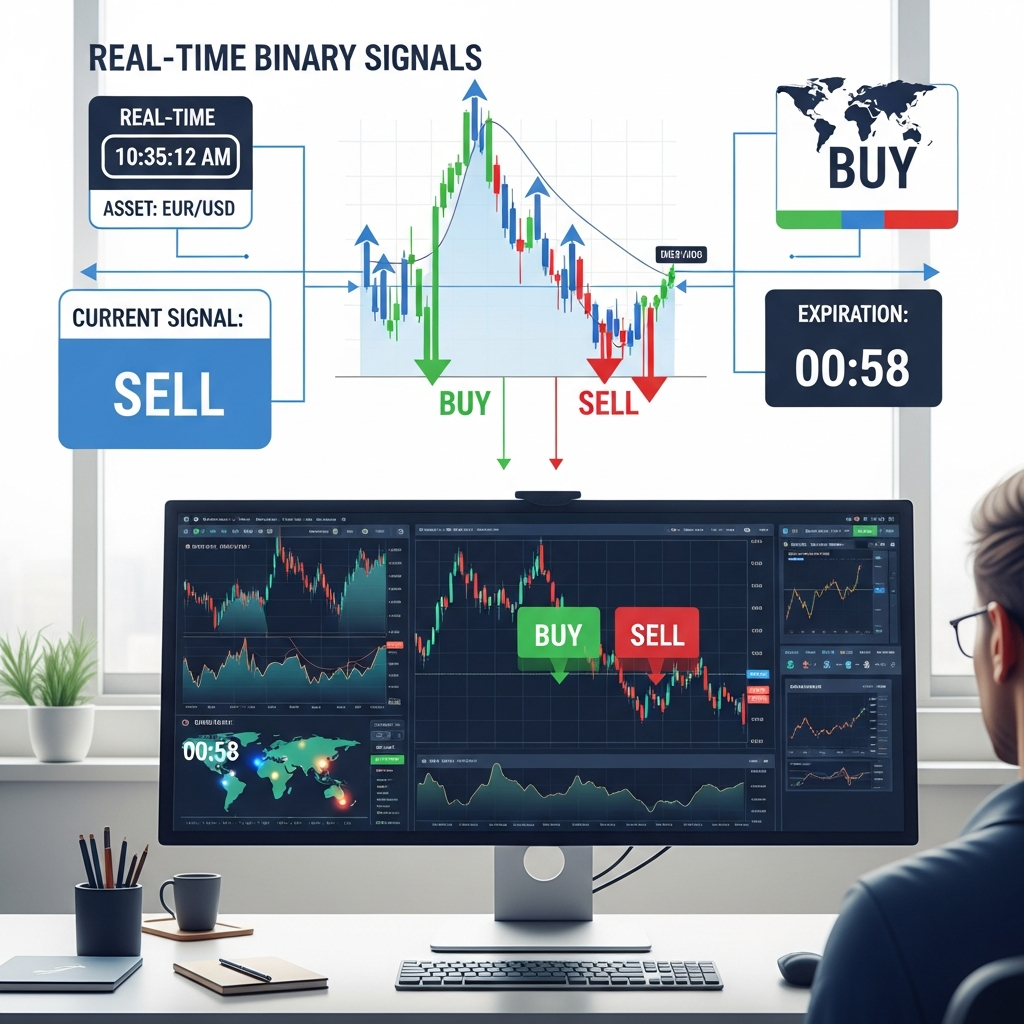
Real-time binary signals are essentially “trade alerts” sent by professional analysts or sophisticated software algorithms. A typical signal includes the asset to be traded (such as EUR/USD, Gold, or Bitcoin), the direction of the trade (Call/High or Put/Low), the strike price, and the expiry time. The “real-time” aspect is critical; because binary options are often traded on short timeframes (60 seconds to 1 hour), any delay in receiving or executing a signal can render it useless.
These signals are designed to simplify the decision-making process. Instead of spending hours staring at complex Japanese Candlestick charts, traders receive a notification on their smartphone, desktop, or directly within their trading platform, indicating that a high-probability setup has occurred.
How Binary Signals Work: The Mechanics
The creation of a signal begins with market analysis. This analysis generally falls into two categories: fundamental and technical. Fundamental analysts look at economic news, interest rate decisions, and geopolitical events. Technical analysts, however, focus on price action and mathematical formulas.
Once specific conditions are met—for instance, a currency pair hitting a significant resistance level while simultaneously showing an overbought condition on an oscillator—a signal is triggered. In the modern era, most real-time binary signals are generated by Algorithmic Trading Bots. These bots can scan hundreds of assets simultaneously, something no human trader can achieve.
Key Technical Indicators Behind the Alerts
To trust a signal, you must understand the logic behind it. Most reputable signal providers use a combination of the following indicators:
1. Relative Strength Index (RSI)
The RSI measures the speed and change of price movements. Signals often trigger when the RSI crosses above 70 (overbought) or below 30 (oversold), suggesting a potential reversal is imminent.
2. Moving Average Convergence Divergence (MACD)
The MACD is a trend-following momentum indicator. Signal providers look for “crossovers” between the MACD line and the signal line to determine the strength of a bullish or bearish move.
3. Bollinger Bands
These bands measure market volatility. When the price touches the upper or lower band, it often signals a regression toward the mean, providing an excellent entry point for a binary trade.
4. Fibonacci Retracement
This tool identifies potential levels of support and resistance based on the golden ratio. Signals generated at these levels are highly valued for their historical accuracy.
Choosing a High-Quality Signal Provider
Not all signal providers are created equal. The internet is flooded with “get rich quick” schemes promising 99% accuracy. In reality, any provider claiming an accuracy rate over 85% consistently is likely fraudulent. Here is how to vet a provider:
- Verified Performance: Look for providers that share their historical data through third-party verification sites.
- Transparency: Does the provider explain why they are suggesting a trade? Knowledge is power.
- Trial Periods: A reputable service will offer a trial period or a low-cost entry point to let you test their signals on a demo account.
- Speed of Delivery: Signals must be delivered via Telegram, SMS, or Push Notification with zero latency.
Manual vs. Automated Signaling Systems
There is an ongoing debate in the trading community: should you execute signals yourself, or let a bot do it? Each has its merits.
Manual Signals: These require you to manually enter the trade into your broker’s platform. The advantage here is control. If a major news event just broke, you can choose to ignore the signal. The disadvantage is the “human lag”—the time it takes to see the alert and click the button.
Automated Signals (Auto-Traders): These systems link the signal provider directly to your brokerage account via an API. When a signal is generated, the trade is executed instantly. This eliminates emotional interference and latency but requires immense trust in the software.

Risk Management and Psychological Discipline
Even the best real-time binary signals will fail occasionally. This is why risk management is non-negotiable. The most common rule is the 1-3% Rule: never risk more than 1% to 3% of your total account balance on a single trade.
Psychology also plays a massive role. When a signal results in a loss, the temptation to “revenge trade” (doubling your stake to win back the loss) is high. Using signals should take the emotion out of the equation. Trust the data, follow the signal, and respect your stop-loss limits.
The Importance of a Trading Journal
To improve your long-term profitability, record every signal you take. Note the asset, the time, the result, and your emotional state. Over time, you may find that certain signals perform better during the London session than the New York session, allowing you to refine your strategy.
Common Pitfalls in Signal-Based Trading
Many traders fail not because the signals were bad, but because their execution was flawed. Common mistakes include:
- Chasing the Trade: Entering a trade minutes after the signal was sent. In binary options, the entry price is everything.
- Over-Trading: Taking every single signal regardless of market conditions. Sometimes the best trade is no trade.
- Ignoring Economic Calendars: Signals are often invalidated by high-impact news like the Non-Farm Payroll (NFP) report.
- Inadequate Capital: Starting with an account too small to sustain the natural win/loss variance of the market.
Frequently Asked Questions
Can real-time binary signals guarantee profits?
No. No legitimate trading tool can guarantee profits. Signals are probabilities, not certainties. Market conditions can change instantly due to unforeseen events.
What is the best timeframe for binary signals?
Most traders find the 5-minute and 15-minute timeframes to be the “sweet spot” for signals. They offer a balance between sufficient data for analysis and quick results.
Do I need a special broker for signals?
While most brokers allow manual signal trading, if you want to use automated signals, you need a broker that supports API integration or specialized trading robots.
Conclusion
Real-time binary signals are a powerful tool in a trader’s arsenal, but they are not a magic wand. Success in the binary options market requires a combination of high-quality alerts, iron-clad risk management, and a commitment to continuous learning. By choosing the right signal provider and maintaining a disciplined approach, you can leverage market volatility to your advantage and move closer to your financial goals.