
Introduction to Synthetic Indices
The world of financial markets is rapidly evolving, and synthetic indices trading has emerged as a powerhouse for retail traders. Unlike traditional currencies or stocks, synthetic indices offer a unique environment where volatility is constant and market hours never end.
Whether you are a seasoned forex veteran or a newcomer, understanding how to navigate these algorithmic markets is crucial. This guide provides an in-depth exploration of the mechanics, strategies, and risks associated with these instruments.
What are Synthetic Indices?
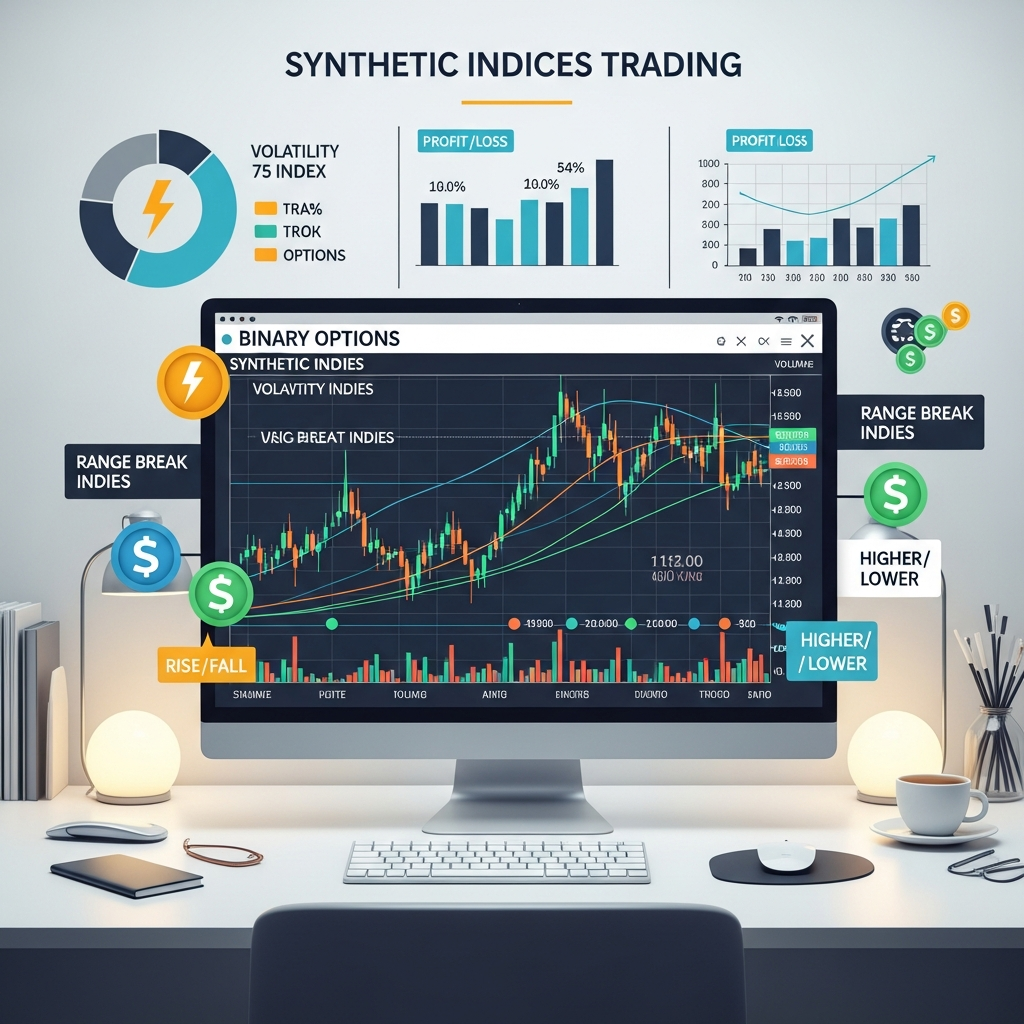
Synthetic indices are financial instruments that mimic the behavior of real-world financial markets but are not influenced by external factors like news, inflation, or geopolitical instability. They are generated by a cryptographically secure random number generator (RNG).
Because these indices are not tied to physical assets or real-world events, they provide a pure environment for technical analysis. Traders can focus entirely on patterns, price action, and indicator-based strategies without worrying about sudden market gaps caused by NFP reports or interest rate hikes.
How the Algorithm Works
The transparency of synthetic indices trading is often a concern for new traders. However, these indices are audited by independent third parties to ensure that the algorithm cannot be manipulated by the broker.
The RNG produces a stream of data points that create the price chart. This ensures that the price movement remains realistic, reflecting supply and demand dynamics through simulated liquidity, even though the underlying driver is mathematical.
Popular Types of Synthetic Indices
Not all synthetic indices behave the same way. Understanding the specific nuances of each category is vital for selecting the right trading strategy.
Volatility Indices
The Volatility 75 Index (V75) is perhaps the most famous. These indices correspond to simulated markets with constant volatilities of 10%, 25%, 50%, 75%, and 100%. V75 is known for its high liquidity and smooth price action, making it a favorite for trend followers.
Boom and Crash Indices
The Boom and Crash series is unique because of its price spikes. In a Boom index (e.g., Boom 1000), the price slowly drifts downward but periodically “spikes” upward. Conversely, Crash indices see sudden drops. These are highly popular for “spike catching” strategies.
Jump Indices
Jump indices simulate markets with a constant volatility but add an element of random “jumps” in price. These are designed to test a trader’s ability to handle sudden volatility shifts within a structured environment.
Synthetics vs. Forex Comparison
To better understand why traders are flocking to these markets, let us compare synthetic indices trading with traditional Forex trading.
| Feature | Synthetic Indices | Forex Market |
|---|---|---|
| Trading Hours | 24/7/365 | 24/5 (Closed Weekends) |
| News Impact | Zero Impact | High Impact |
| Volatility | Constant/Fixed | Variable (Low to High) |
| Analysis Type | Strictly Technical | Technical & Fundamental |
Expert Trading Strategies

To succeed in synthetic indices trading, you need a disciplined approach. Since fundamentals are non-existent, your edge must come from market structure and statistical probability.
Price Action and Market Structure
Identifying support and resistance levels is the foundation of any successful trader. In Volatility indices, price often respects historical levels with high precision. Look for break and retest patterns on higher timeframes like H1 or H4.
Technical Indicators
Many traders use the Relative Strength Index (RSI) and Moving Averages to filter trades. A common setup involves using a 50-period EMA to determine the trend and the RSI to identify overbought or oversold conditions during pullbacks.
Spike Catching in Boom and Crash
For Boom and Crash, traders often look for order blocks or demand zones on lower timeframes (M1 or M5). When the price enters a historical spike zone, traders enter with tight stop losses to capture the explosive move.
Risk Management and Psychology
Despite the opportunities, synthetic indices trading carries significant risk due to high leverage. Professional risk management is the only way to ensure long-term profitability.
- Lot Size Selection: Synthetic indices have different contract specifications. Always calculate your risk per pip before entering.
- Stop Loss Usage: Never trade without a hard stop loss. In Boom and Crash, be aware that spikes can sometimes bypass stop losses if they occur exactly at your entry level.
- Daily Limits: Set a maximum loss limit for the day. If you reach it, stop trading to avoid emotional “revenge trading.”
Psychologically, trading 24/7 can be exhausting. The market is always open, but that doesn’t mean you should always be in a trade. Patience is your most valuable asset.
Frequently Asked Questions
What are synthetic indices in trading?
Synthetic indices are unique financial instruments that simulate real-world market movements but are generated by cryptographically secure computer algorithms. Unlike traditional assets, they are available for trading 24/7.
Are synthetic indices affected by news events?
No, synthetic indices are independent of global economic news, political events, or central bank decisions. Their price movement is dictated solely by an algorithm, making them ideal for technical analysis.
Which platform is best for synthetic indices?
The most widely used platform for synthetic indices is Deriv.com, which provides access via MetaTrader 5 (MT5) and their proprietary DTrader platform.