


The Ultimate Guide to Deriv Bot Money Management Strategy
Automated trading through platforms like Deriv’s DBot has revolutionized the way retail traders interact with financial markets. However, the allure of ‘passive income’ often blinds beginners to the most critical aspect of trading: Money Management. Without a robust Deriv Bot money management strategy, even the most sophisticated algorithm will eventually succumb to market volatility and deplete your account balance.
In this comprehensive guide, we will explore the mathematical foundations of risk management, compare popular betting systems adapted for DBot, and provide actionable steps to safeguard your capital while maximizing your profit potential.
Why Money Management is the Backbone of DBot Success
Trading bots are emotionless; they execute logic precisely as programmed. While this eliminates human errors like revenge trading or hesitation, it also means a bot will happily execute a losing strategy until your balance hits zero if you haven’t set proper boundaries. Money management is the art of defining those boundaries.
Effective money management on Deriv serves three primary purposes:
- Capital Preservation: Ensuring you stay in the game long enough to hit a winning streak.
- Risk Mitigation: Controlling the maximum loss per trade and per session.
- Profit Optimization: Knowing when to compound earnings and when to walk away.
Core Components of a DBot Risk Strategy
Before selecting a specific mathematical strategy, every trader must understand the foundational settings within the Deriv Bot interface.
1. Initial Stake and Contract Type
Your initial stake should represent a tiny fraction of your total balance. A common rule of thumb is 1% to 2%. If you have $100, your initial stake should be $1. Choosing the right contract (e.g., Rise/Fall, Over/Under, Even/Odd) significantly impacts your ‘Win Probability,’ which in turn dictates which money management system is appropriate.
2. Stop Loss (Total Loss Limit)
This is your absolute safety net. A stop-loss tells the bot to stop trading once a specific amount of money has been lost in a session. Without this, a ‘black swan’ event or a long losing streak could wipe out your entire account.
3. Take Profit (Target Profit)
Greed is the enemy of the automated trader. Setting a Take Profit ensures that you lock in gains. For most Deriv Bot users, a daily target of 5% to 10% of the account balance is sustainable. Attempting to double an account daily is a recipe for disaster.
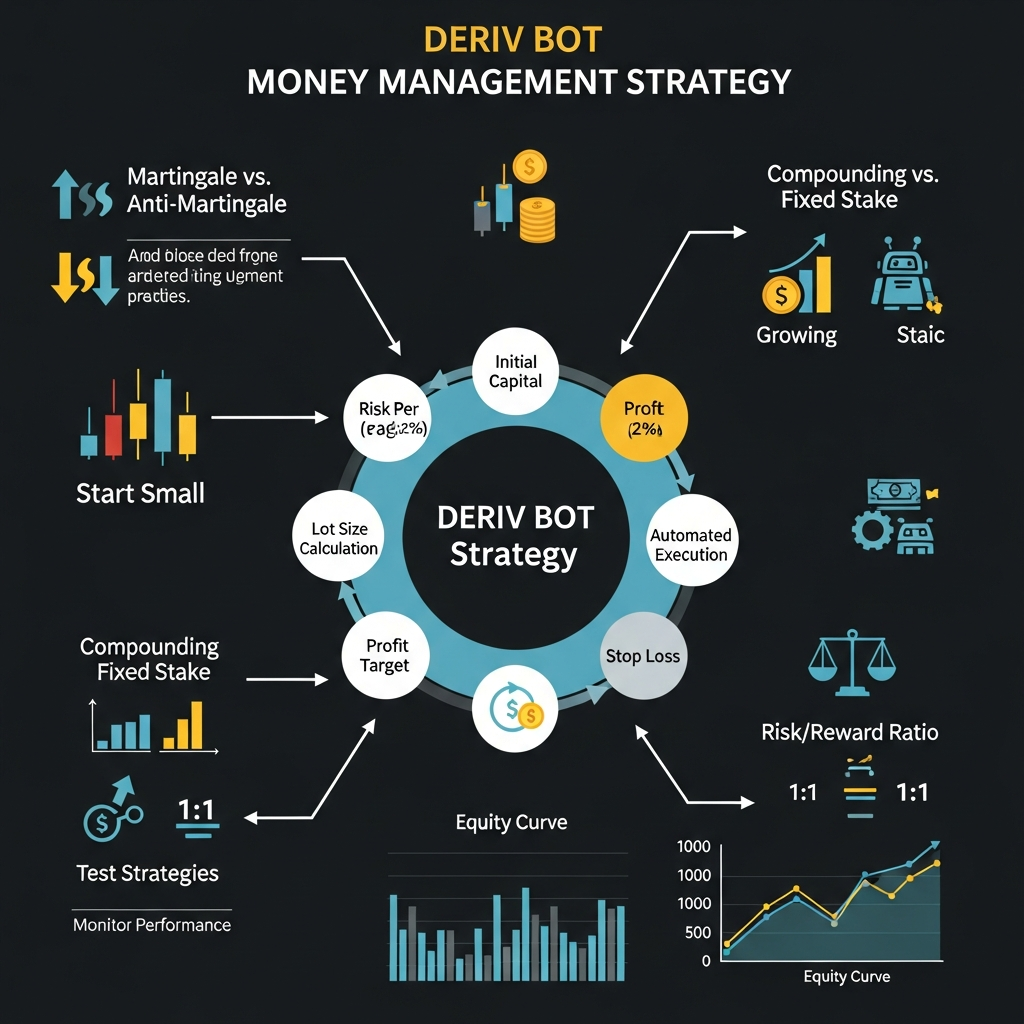
Popular Deriv Bot Money Management Strategies
Depending on your risk tolerance, you can program various mathematical models into your DBot. Here are the most common strategies used by professional bot developers.
1. The Martingale Strategy (High Risk)
The Martingale is perhaps the most famous—and dangerous—strategy in the world of binary and volatility index trading. The logic is simple: after every loss, you double your stake. When you eventually win, you recover all previous losses plus a profit equal to your original stake.
- Pros: Recovers losses quickly; high win rate for individual cycles.
- Cons: Requires a massive balance; a streak of 7-10 losses can lead to a ‘Margin Call’ or hitting the platform’s maximum stake limit.
DBot Implementation: You use the ‘Loss’ logic block to multiply the ‘Stake’ by a factor (usually 2.0 or 2.1 depending on the payout).
2. The D’Alembert System (Balanced Risk)
For those who find Martingale too aggressive, the D’Alembert system offers a middle ground. Instead of doubling the stake, you increase it by a fixed unit (e.g., $1) after a loss and decrease it by a fixed unit after a win.
This system is based on the ‘Equilibrium’ theory, assuming that over time, your wins and losses will even out. It protects your balance much better than Martingale during extended losing streaks.
3. The Oscar’s Grind Strategy
Oscar’s Grind is a ‘positive progression’ strategy. The goal is to make one unit of profit per cycle. If you lose, the stake remains the same. If you win, you increase the stake by one unit, provided that the win doesn’t result in more than the target profit for that cycle. It is designed to capitalize on winning streaks while minimizing the impact of losing streaks.
4. The Compound Interest (Parlay) Strategy
In direct contrast to Martingale, the Parlay system increases the stake after a win. You take your initial stake plus the profit from the previous trade and reinvest it in the next trade. This is excellent for bots with high accuracy but low payouts.
Building Advanced Logic in DBot Editor
To implement a successful Deriv Bot money management strategy, you need to master ‘Block 4’ (the ‘Finish’ block) in the DBot workspace. This is where the bot decides what to do next based on the result of the last trade.
Setting Up a ‘Smart Martingale’
Standard Martingale is risky because it never stops. A ‘Smart Martingale’ includes logic to reset the stake after a certain number of losses or to stop the bot entirely if the stake exceeds a specific threshold. This prevents the bot from attempting a $500 trade to recover a $1 loss.
Integrating a ‘Global’ Stop Loss
Many traders make the mistake of only setting a stop loss within the bot’s temporary variables. It is safer to use the ‘Total Profit/Loss’ variable provided by Deriv. Your logic should look like this:
If (Total Profit) is LESS than (Negative Stop Loss Value), then (Stop Trading).
Common Pitfalls to Avoid
Even with a great strategy, many traders fail due to these common mistakes:
- Overtrading: Running a bot 24/7 is not recommended. Markets change behavior (trending vs. ranging). A bot designed for a ranging market will fail in a trending market.
- Insufficient Capital for Martingale: If you use Martingale, ensure your balance can sustain at least 10 consecutive losses.
- Ignoring Market Conditions: Money management cannot save a bot that is trading against the market trend. Always check the charts (DTrader or MT5) before starting your DBot.

The Importance of Backtesting and Demo Trading
Never deploy a new Deriv Bot money management strategy on a real account without extensive testing. Deriv provides a Virtual (Demo) account for a reason.
- Run the bot for 1000+ trades on the demo account.
- Analyze the ‘Maximum Drawdown’: What was the lowest your balance dropped during the test?
- Adjust Variables: If the drawdown is more than 30% of your intended real balance, reduce your initial stake or change the multiplier.
The Psychological Aspect of Automated Trading
It sounds counterintuitive, but psychology plays a huge role in bot trading. The ‘Management’ in money management includes you. The temptation to manually intervene when a bot is in a losing streak is high. Conversely, when a bot is winning, many traders remove their Take Profit, only to see the market reverse and wipe out the gains.
Stick to the plan. If your strategy was built on sound mathematics and tested on demo, trust the process. If the bot hits the stop loss, turn it off and analyze the market. Do not ‘revenge trade’ by increasing the stake manually.
Conclusion: Creating Your Custom Blueprint
There is no single ‘best’ Deriv Bot money management strategy, but the most sustainable one is usually a hybrid. A combination of a modest D’Alembert progression with a strict daily Take Profit of 3% is often more successful long-term than an aggressive Martingale.
Summary Checklist for Your DBot:
- Set an initial stake no higher than 1% of your balance.
- Define a clear Stop Loss and Take Profit in Block 4.
- Choose a progression logic (Martingale, D’Alembert, or Fixed) based on your win rate.
- Backtest on a Demo account for at least 48 hours.
- Monitor market volatility before hitting ‘Run’.
By treating your Deriv Bot as a business tool rather than a gambling machine, and by implementing the money management strategies outlined above, you position yourself in the top percentage of traders who actually find consistency in the synthetic indices and forex markets.