
Introduction to the Algorithmic Evolution in Binary Options
The financial markets have undergone a radical transformation over the last decade. In the world of binary options—a derivative where the payoff is either a fixed monetary amount or nothing at all—the shift toward automation is more than just a trend; it is a necessity for competitive edge. Algorithmic binary options trading involves the use of computer programs to execute trades based on pre-defined criteria, such as price movements, technical indicators, or economic data releases.
While manual trading relies on human intuition and emotional discipline, algorithmic systems leverage pure data. In a market where a single second can determine whether a trade ends "In the Money" (ITM) or "Out of the Money" (OTM), the speed and precision of an algorithm are unparalleled. This guide explores the technical architecture, strategic implementation, and risk management protocols essential for mastering automated binary trading.
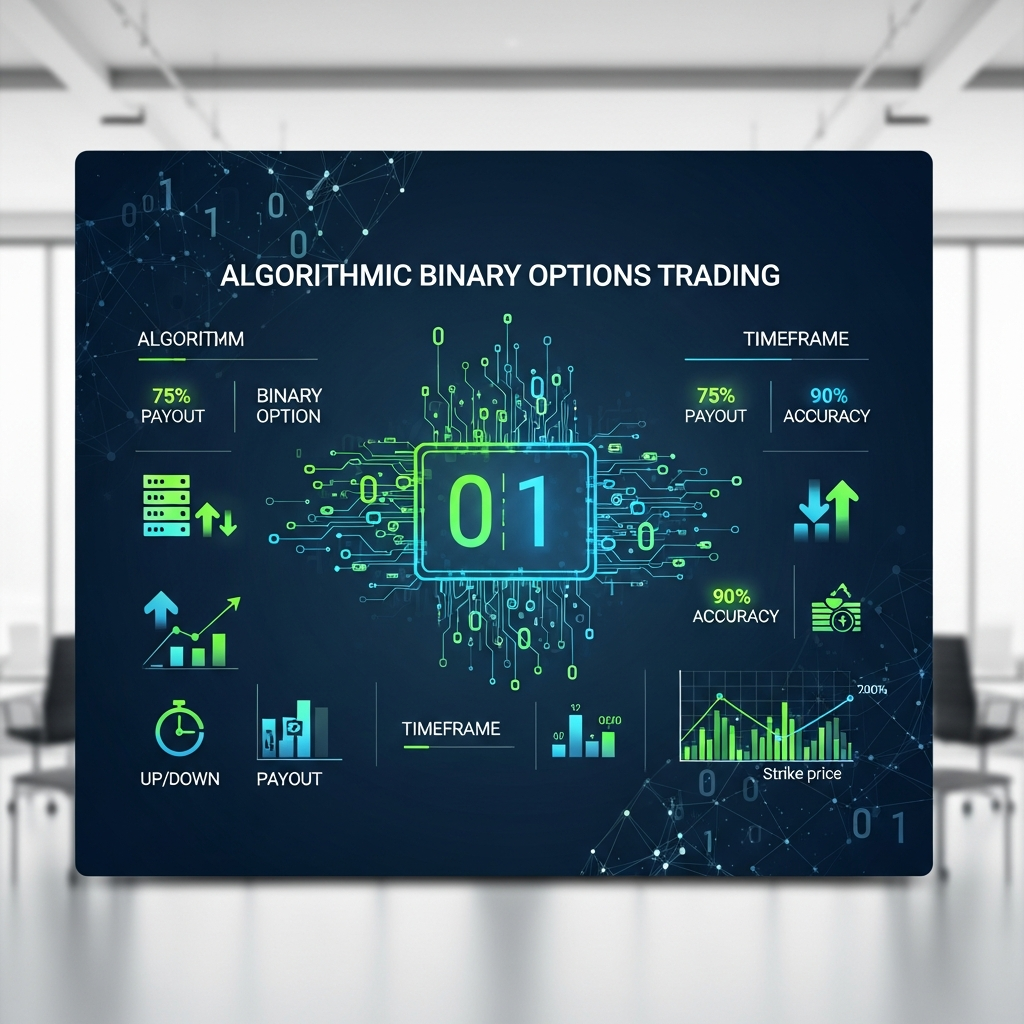
What is Algorithmic Binary Options Trading?
At its core, algorithmic binary options trading is the process of translating a trading strategy into a set of logical instructions. Binary options are uniquely suited for algorithms because of their binary nature: you are essentially predicting a Boolean outcome (True/False) over a fixed time horizon. Unlike Forex or Equities where you must manage variable take-profits and stop-losses, binary options only require the algorithm to predict if the price will be above or below a certain strike price at the time of expiration.
These algorithms, often referred to as "bots," connect to a broker’s server via an Application Programming Interface (API). They monitor price feeds in real-time, calculate technical indicators (like Moving Averages or RSI), and execute trades instantly when the conditions of the logic are met. This allows for high-frequency trading (HFT) strategies that would be impossible for a human to replicate.
The Core Benefits of Automation
The transition from manual to automated trading offers several distinct advantages that can significantly impact a trader’s bottom line.
1. Execution Speed and Efficiency
In the binary industry, prices move in milliseconds. A human trader must see a signal, process it, decide on the investment amount, and click a button. This delay, known as latency, can lead to slippage. An algorithm, however, can execute a trade the microsecond a signal is generated, ensuring the best possible entry price.
2. Removal of Emotional Bias
Fear and greed are the primary reasons manual traders fail. After a series of losses, a human might hesitate on a valid signal or "revenge trade" with larger stakes. An algorithm follows the script regardless of previous outcomes, maintaining the statistical integrity of the strategy.
3. Ability to Multi-Task
A human can realistically monitor two or three asset pairs at a time. An algorithm can simultaneously scan hundreds of assets across multiple brokers, identifying opportunities across the entire global market at once.
The Technical Stack: APIs and Languages
Building a trading bot requires a solid foundation in software development. While there are "drag-and-drop" bot builders available, professional-grade algorithmic trading requires coding.
Programming Languages: Python is the most popular choice due to libraries like Pandas (for data manipulation), NumPy (for mathematical calculations), and TA-Lib (for technical analysis). Node.js is another strong contender, especially for its WebSocket capabilities, which allow for a constant, low-latency stream of price data.
Broker APIs: Not all brokers support algorithmic trading. Industry leaders like Deriv (formerly Binary.com) and Pocket Option provide comprehensive API documentation. These APIs allow developers to fetch historical data, subscribe to real-time ticks, and place trades programmatically. Utilizing a WebSocket connection is critical; unlike traditional REST APIs, WebSockets keep a connection open, allowing the broker to "push" data to the bot without the bot having to ask for it repeatedly.

Developing a Robust Trading Strategy
A bot is only as good as the logic it follows. When developing an algorithm for binary options, traders typically focus on three types of strategies:
Mean Reversion
This strategy assumes that price will eventually return to its average. If a price moves significantly away from a Bollinger Band or a Moving Average, the algorithm bets on a reversal. This is particularly effective in ranging markets.
Trend Following
Trend-following algorithms use indicators like the ADX (Average Directional Index) or Ichimoku Cloud to identify the direction of the market and place "Call" or "Put" trades in the direction of the momentum. This is the most common approach for longer expiration times.
Statistical Arbitrage
In binary options, this might involve monitoring correlated assets (like Gold and USD). If one asset moves while the other lags, the algorithm places a trade expecting the correlation to hold and the lag to close.
Risk Management and Money Management
In algorithmic binary options trading, how you manage your capital is just as important as your entry signal. Because the payout is usually between 70% and 95%, you must win significantly more than 50% of your trades to be profitable.
- Fixed Staking: The safest method. The bot invests a set percentage of the balance (e.g., 1%) on every trade.
- Martingale: A high-risk strategy where the bot doubles the investment after a loss. While popular in the binary industry, it can lead to a "black swan" event that wipes out an entire account.
- Kelly Criterion: A mathematical formula used to determine the optimal size of a series of bets to maximize the logarithm of wealth.
Your algorithm must include hard-coded limits, such as a "Daily Stop Loss" and a "Maximum Drawdown" threshold. If the bot loses a certain amount in a 24-hour period, it should automatically shut down to prevent further losses during unfavorable market conditions.
The Importance of Rigorous Backtesting
Before deploying an algorithm in a live environment, it must undergo backtesting. This involves running the algorithm against historical market data to see how it would have performed in the past. However, traders must beware of Overfitting (or curve-fitting). This occurs when an algorithm is so finely tuned to past data that it fails to predict future movements. A robust bot should perform well across different market cycles and timeframes.
Forward testing (or paper trading) is the next step. Most binary brokers offer demo accounts where you can run your bot with virtual money. A minimum of 500 to 1,000 trades in a demo environment is recommended before committing real capital.
Common Pitfalls and Ethical Considerations
The binary industry is unfortunately rife with "scam bots" promising guaranteed returns. It is vital to remember that no algorithm can predict the future with 100% certainty.
Latency Arbitrage: Some traders attempt to exploit the delay between a fast data feed and a slow broker price. While profitable, this is often against the broker’s terms of service and can lead to the permanent freezing of funds. Always ensure your bot operates within the legal and ethical guidelines of the platform you are using.
The Future: AI and Machine Learning in Binary Options
The next frontier in algorithmic binary options trading is the integration of Artificial Intelligence (AI) and Machine Learning (ML). Unlike traditional algorithms that follow rigid "if-then" rules, ML models can learn from new data and adapt their parameters over time.
Neural networks can analyze thousands of variables—including sentiment analysis from news headlines and social media—to predict price movements. As computational power increases and AI becomes more accessible, the barrier between retail traders and institutional-grade technology continues to dissolve. For the modern binary options trader, the path to consistent profitability lies in the fusion of deep market knowledge and sophisticated automated execution.
Frequently Asked Questions
Do I need to leave my computer on for the bot to trade?
While you can run a bot on a local machine, most professional traders use a Virtual Private Server (VPS). This ensures the bot runs 24/7 with a stable internet connection and minimal latency, even if your personal computer is turned off.
Is there a limit to how much I can trade with an algorithm?
Brokers often have maximum trade limits per asset. Additionally, if an algorithm is too successful, some brokers may limit the maximum investment amount or reduce the payout percentage for that specific account. Choosing a reputable, regulated broker is essential.
Can I use MT4 or MT5 for binary options?
Yes, many traders use MetaTrader 4 or 5 to generate signals and then use a "bridge" software to send those signals to their binary options broker via API. This allows you to use the advanced charting and Expert Advisor (EA) capabilities of MetaTrader.