
Mastering Binary Signals API: The Ultimate Technical Guide to Automated Trading
In the high-stakes world of binary options and short-term financial markets, the difference between a profitable trade and a loss is often measured in milliseconds. As the industry evolves from manual chart analysis to sophisticated algorithmic execution, the binary signals API has emerged as the cornerstone for modern traders. Whether you are a developer building a custom trading bot or a retail trader looking to enhance your speed, understanding how to leverage these programmatic interfaces is essential.
What is a Binary Signals API?
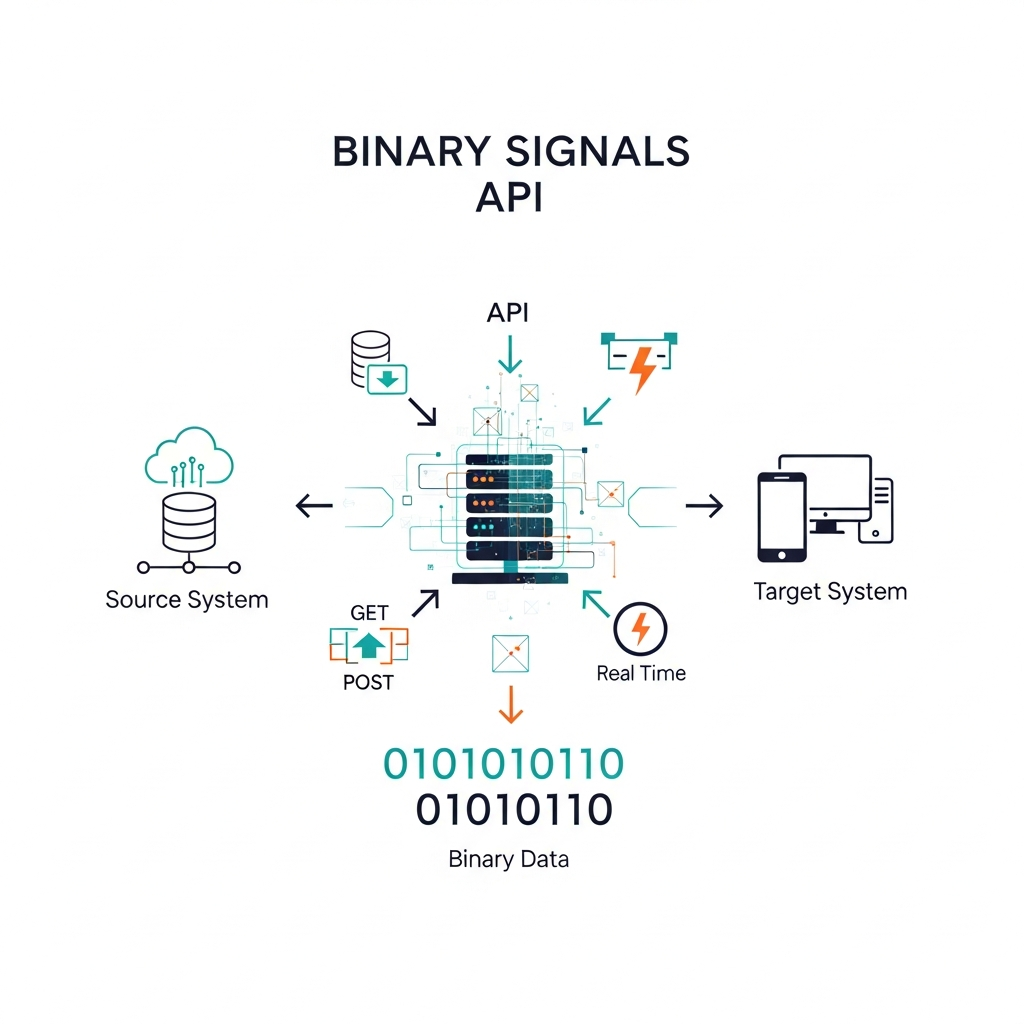
A binary signals API (Application Programming Interface) is a set of protocols and tools that allows your software to communicate directly with a signal provider’s server. Instead of a human looking at a dashboard and manually placing a trade, the API sends structured data (usually in JSON format) containing the asset, the direction (Call/Put), the expiry time, and the confidence level.
The binary industry relies heavily on these APIs to bridge the gap between data analysis and order execution. By utilizing an API, you eliminate the “human lag”—the time it takes for a person to perceive a signal and physically click a button. In binary options, where expiries can be as short as 60 seconds, this speed is non-negotiable.
The Technical Architecture of Trading APIs
Most modern binary signals APIs operate through two primary communication methods: RESTful endpoints and WebSockets. Understanding the difference is crucial for optimizing your trading setup.
REST APIs vs. WebSockets
REST (Representational State Transfer) is the standard for request-response communication. Your bot asks the server, “Is there a new signal for EUR/USD?” and the server responds. This is excellent for backtesting or retrieving historical data but can be slightly slower for live trading due to the overhead of opening new connections.
WebSockets, on the other hand, provide a full-duplex communication channel. Once the connection is open, the server “pushes” signals to your bot the moment they are generated. This is the gold standard for high-frequency binary trading because it minimizes latency.
Key Features to Look for in a Provider
Not all binary signals APIs are created equal. When evaluating a provider, you must look beyond the marketed “win rate” and examine the technical specifications that actually impact your bottom line.
- Latency: The time it takes for a signal to travel from the provider to your API client should be in the low milliseconds.
- Asset Coverage: Does the API support Forex, Commodities, Indices, and Crypto? Diversification is key to managing market volatility.
- Data Granularity: A robust API provides more than just “Buy/Sell.” It should provide the entry price, current volatility index, and historical success rates for that specific asset.
- Uptime and Reliability: Look for providers that offer a Service Level Agreement (SLA). If the API goes down during a volatile market session, you could be left with open risks.
Step-by-Step Integration Strategy
Integrating a binary signals API requires a basic understanding of programming (Python, Node.js, or C# are popular choices). Below is the typical workflow for a professional integration.
1. Authentication
Most providers use API Keys or OAuth2. You must include your unique key in the header of every request to prove you have a valid subscription. Security is paramount here; never hard-code your keys in public repositories.
2. Parsing the JSON Payload
Signals arrive as JSON objects. A typical payload might look like this:
{
  "signal_id": "12345",
  "pair": "GBPUSD",
  "action": "CALL",
  "expiry": "300",
  "confidence": 0.89
}
Your code must parse this data and map it to your broker’s execution API. This translation layer is where you can add custom filters, such as only taking trades with a confidence score above 85%.
3. Execution and Feedback Loop
Once your bot receives the signal, it sends an execution command to the broker. A sophisticated system will then “listen” for the result of that trade and feed it back into a local database to track performance in real-time.

Advanced Risk Management via API
Using a binary signals API isn’t just about finding trades; it’s about managing them intelligently. Professional developers implement several layers of risk management directly into their API client.
Dynamic Stake Calculation
Instead of a fixed trade amount, your code can calculate the stake based on your current balance and the “confidence” parameter provided by the signal API. This is known as the Kelly Criterion or fractional position sizing, which helps protect your capital during losing streaks.
Circuit Breakers
Automated systems can trade 24/7, but they can also lose money 24/7 if the market conditions change (e.g., major news events). By monitoring the API feed for volatility spikes, your bot can automatically trigger a “circuit breaker” to pause trading until the market stabilizes.
The Future of AI-Driven Signals
The industry is moving toward Machine Learning (ML) integrated APIs. Traditional signals were based on fixed technical indicators like RSI or MACD. The next generation of binary signals APIs uses neural networks to analyze sentiment from news feeds, social media, and order flow data simultaneously.
These AI-driven APIs can adapt to changing market cycles in ways a static algorithm cannot. For developers, this means the integration logic will become more complex, requiring handling for “soft” signals and probability distributions rather than simple binary directions.
Frequently Asked Questions
Can I use multiple binary signals APIs at once?
Yes, many advanced traders use a “voting” system where they only execute a trade if two or three different API providers agree on the direction. This increases the probability of a successful outcome.
Do these APIs work with MetaTrader 4 (MT4)?
Most binary signals APIs can be integrated into MT4 using an ‘Expert Advisor’ (EA) written in MQL4. The EA acts as the bridge between the external API and the MT4 terminal.
What is the cost of a typical binary signals API?
Prices range from free (often limited or delayed) to several hundred dollars per month for institutional-grade feeds with low latency and high-frequency updates.
Conclusion
The transition to a binary signals API is a transformative step for any trader. By removing the emotional component of trading and replacing it with data-driven, programmatic execution, you position yourself to scale your strategies effectively. As with any technology, the key lies in the quality of the data and the robustness of your integration. Start by choosing a reliable provider, focus on minimizing latency, and always prioritize risk management in your code.