
Introduction to DBot and Automated Binary Trading
In the fast-paced world of financial markets, automation has transitioned from a luxury for institutional investors to a standard tool for retail traders. DBot, the premier automated trading platform by Deriv, allows users to build, backtest, and deploy trading robots without writing a single line of code. However, the tool is only as effective as the dbot binary bot strategy it executes. This guide explores the depths of creating a robust, profitable strategy that balances risk and reward in the volatile world of synthetic indices and forex.
Table of Contents
- What is DBot and How Does It Work?
- The Core Components of a Successful DBot Strategy
- Top 3 DBot Binary Bot Strategies for 2024
- Risk Management: The Backbone of Your Bot
- How to Backtest and Optimize Your Strategy
- Advanced Logic: Using Custom Blocks and Indicators
- Common Pitfalls to Avoid in Automated Trading
- Frequently Asked Questions (FAQ)
- Conclusion
What is DBot and How Does It Work?
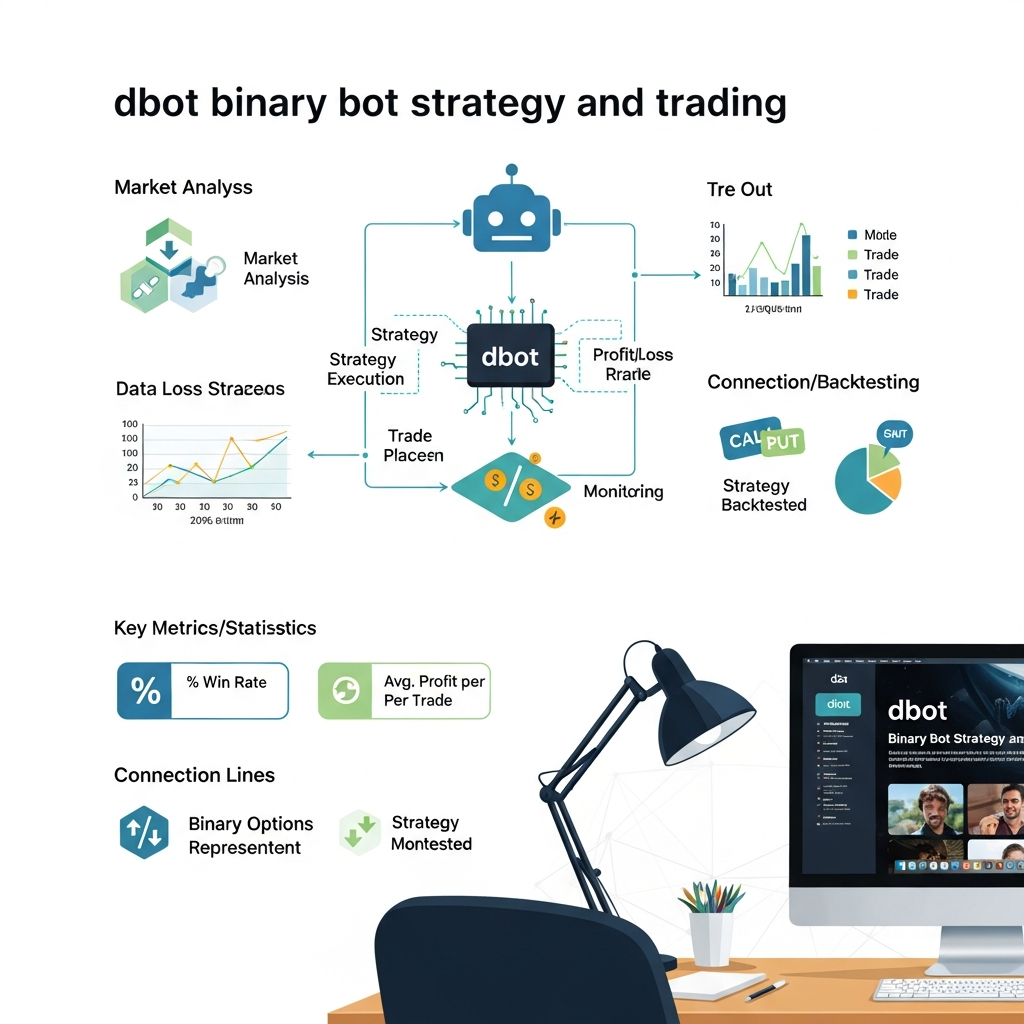
DBot is a web-based platform that utilizes a visual programming interface—often referred to as “blocks.” By dragging and dropping blocks that represent different logic sequences, traders can define exactly when a trade should be opened, how much to stake, and when to stop trading. Unlike manual trading, a dbot binary bot strategy removes the emotional bias that often leads to impulsive decisions and catastrophic losses.
The platform primarily operates on the Deriv ecosystem, offering access to synthetic indices (like Volatility 100 or Boom and Crash), Forex, and Commodities. The beauty of the system lies in its 24/7 availability, especially with synthetic indices, which are governed by cryptographically secure random number generators rather than traditional market hours.
The Core Components of a Successful DBot Strategy
To build a high-performing bot, you must understand the four primary blocks in the DBot environment:
- Trade Parameters: This is where you define the market, the type of trade (Rise/Fall, Over/Under, Even/Odd), and the contract duration (ticks, seconds, minutes).
- Purchase Logic: The “Brain” of the bot. This block uses technical indicators (like RSI or Moving Averages) to decide when to enter a trade.
- Sell Logic: Used for contracts that allow premature closing, though rarely used in high-speed binary trading.
- Post-Trade Logic: This is where your money management resides. It tells the bot what to do after a win or a loss (e.g., reset stake or increase it via Martingale).

Top 3 DBot Binary Bot Strategies for 2024
1. The RSI Mean Reversion Strategy
The Relative Strength Index (RSI) is a staple in binary trading. A classic DBot strategy involves setting the RSI period to 14. When the RSI value dips below 30, the bot executes a “Rise” (Call) trade. Conversely, when the RSI exceeds 70, it executes a “Fall” (Put) trade. This strategy performs exceptionally well in ranging markets.
2. The Trend-Following EMA Cross
By using two Exponential Moving Averages (EMA)—a fast one (9 periods) and a slow one (21 periods)—you can capture momentum. The logic is simple: when the 9-EMA crosses above the 21-EMA, the bot buys a “Rise” contract. This is particularly effective on high-volatility indices like Volatility 75 (1s).
3. The Over/Under Digit Strategy
Many traders prefer the “Digit” markets. A popular strategy is the “Over 2” strategy. Statistically, the last digit of a price has a higher probability of being above 2 than exactly 0, 1, or 2. By combining this with a mild Martingale multiplier, traders can achieve a high win rate, though the risk of a long losing streak must be managed.
Risk Management: The Backbone of Your Bot
No dbot binary bot strategy is complete without a strict risk management framework. Automated systems can drain an account in minutes if not properly constrained. Below is a table highlighting essential risk parameters:
| Parameter | Description | Recommended Setting |
|---|---|---|
| Stake Amount | The initial amount per trade. | 0.5% – 1% of Balance |
| Stop Loss | Total loss allowed before the bot stops. | 10% – 20% of Balance |
| Take Profit | Target profit for the session. | 5% – 10% of Balance |
| Martingale Multiplier | Factor by which the stake increases after a loss. | 2.0x – 2.2x |
| Max Loss Level | Max consecutive losses allowed. | 5 – 7 steps |
How to Backtest and Optimize Your Strategy
Before going live, you must test your bot. Deriv provides a “Virtual Account” with $10,000 in play money. Run your bot for at least 48 hours in different market conditions. Look for the following metrics:
- Maximum Drawdown: What was the largest dip in balance?
- Win/Loss Ratio: Does the strategy win more than 55% of the time (for 1:1 payouts)?
- Recovery Time: How long does it take the bot to recover from a losing streak?
Advanced Logic: Using Custom Blocks and Indicators
For those looking to advance, DBot allows for “Variables” and “Lists.” You can create a bot that records the last 10 digits and only trades when a specific number hasn’t appeared for a set amount of time (the “Missing Digit” theory). Furthermore, you can integrate external signals via webhooks if you are using platforms like TradingView, though this requires more technical knowledge.
Common Pitfalls to Avoid in Automated Trading
Many beginners fail because they treat DBot as a “set and forget” money machine. Avoid these mistakes:
- Over-leveraging: Using a 10% stake on a small account.
- Chasing Losses: Using an infinite Martingale without a stop-loss.
- Trading During News: While synthetic indices aren’t affected by news, Forex pairs are. High volatility during news can break indicator-based strategies.
- Poor Logic: Creating a bot that trades too frequently (overtrading), leading to excessive commission/spread costs.
Frequently Asked Questions (FAQ)
Is DBot trading legal?
Yes, trading via DBot is legal in jurisdictions where the broker (Deriv) is licensed to operate. However, always check your local regulations regarding binary options and synthetic indices.
How much money do I need to start?
You can start with as little as $5 or $10 on some platforms, but for a bot using Martingale, a minimum of $100 is recommended to withstand potential losing streaks.
Can I run DBot on my phone?
Yes, the DBot interface is mobile-responsive, but for the best experience in building and monitoring complex bots, a desktop browser is recommended.
Do I need to keep my computer on?
If you are running the bot in your browser, the tab must remain open. For 24/7 operation, many traders use a Virtual Private Server (VPS).
Conclusion
Developing a successful dbot binary bot strategy requires a blend of technical analysis, rigorous testing, and disciplined risk management. Whether you choose a simple RSI crossover or a complex digit-based algorithm, the key is consistency. Remember that no bot is 100% profitable; the goal is to have an edge over the market that results in long-term growth. Start on a demo account, refine your logic, and only trade with capital you can afford to lose. The future of trading is automated—ensure your strategy is ready for it.