
Introduction: The Battle of Two Broker Giants
Choosing the right brokerage is one of the most critical decisions a trader can make. In the retail trading landscape, two names frequently surface with distinct value propositions: Deriv and IC Markets. While both provide access to global financial markets, they cater to fundamentally different types of traders.
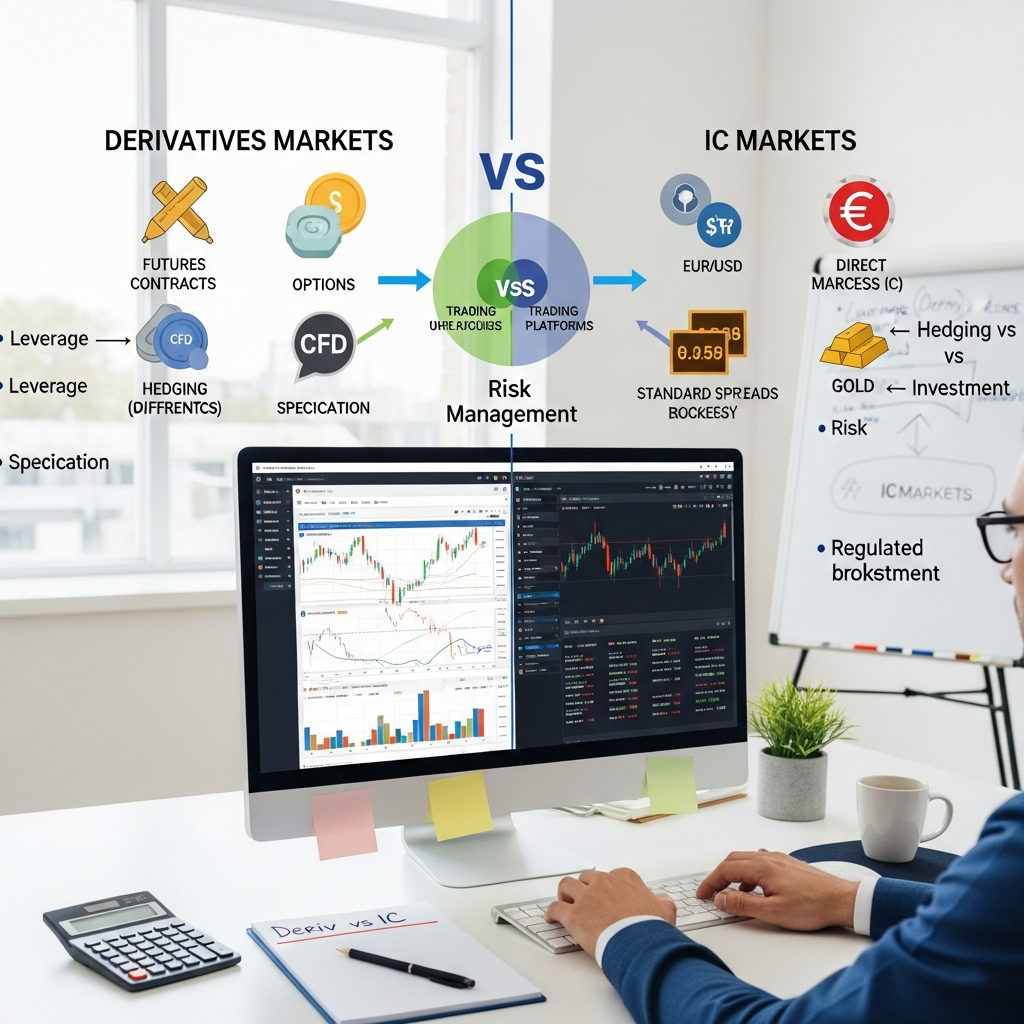
Deriv is widely celebrated for its innovative proprietary platforms and unique Synthetic Indices, which allow for 24/7 trading. IC Markets, on the other hand, is the gold standard for ECN (Electronic Communication Network) trading, offering some of the lowest spreads in the industry and institutional-grade liquidity. In this deep-dive comparison, we will analyze every technical aspect from execution speeds to regulatory oversight.
Table of Contents
Regulation and Security: Who Can You Trust?
Regulation is the backbone of fund safety. IC Markets is often viewed as a more “traditional” powerhouse in this regard. It is regulated by the Australian Securities and Investments Commission (ASIC) and the Cyprus Securities and Exchange Commission (CySEC), both of which are Tier-1 regulatory bodies. This ensures high levels of capital adequacy and investor protection.
Deriv (formerly Binary.com) has a long history spanning over two decades. It operates under several licenses, including the Malta Financial Services Authority (MFSA), the Labuan Financial Services Authority (LFSA), and the British Virgin Islands Financial Services Commission. While it lacks a direct Tier-1 license like ASIC, its longevity and global footprint provide significant credibility.
Asset Classes and Trading Instruments
This is where the two brokers diverge most sharply. If you are looking for specific types of volatility, your choice might be made for you here.
IC Markets: The Forex and CFD Specialist
IC Markets offers a massive range of over 2,250 instruments. This includes:
- Forex: 60+ currency pairs with deep liquidity.
- Commodities: 20+ including metals, energies, and soft commodities.
- Indices: Global indices like the S&P 500 and DAX 40.
- Stocks & Crypto: Large-cap equities and major cryptocurrencies.
Deriv: The Home of Synthetic Indices
Deriv offers Forex and traditional assets, but their unique selling point is Synthetic Indices. These are markets simulated by a secure, cryptographically protected random number generator. They mimic real-world market movements but are not affected by global news or events, making them available 24/7, 365 days a year.
Traders who want to trade on weekends or during bank holidays often choose Deriv specifically for these assets, which include Volatility 10, 75, and 100 indices, as well as Boom/Crash and Jump indices.
Trading Platforms: Proprietary vs. Standard
A broker’s technology stack determines how efficiently you can enter and exit trades.
The IC Markets Ecosystem
IC Markets sticks to the industry standards, but they provide the best versions of them:
- MetaTrader 4 & 5: Fully supported with no restrictions on EAs (Expert Advisors) or scalping.
- cTrader: A modern, intuitive platform built for ECN trading with advanced depth-of-market features.
The Deriv Ecosystem
Deriv provides a more diverse, custom-built experience:
- DTrader: A web-based platform designed for simplicity and ease of use.
- Deriv MT5 (DMT5): A powerful integration of MetaTrader 5 with access to all Deriv assets.
- DBot: An automated trading bot builder that requires zero coding knowledge, allowing users to automate strategies easily.
- SmartTrader: Optimized for options trading.

Fee Structures: Spreads and Commissions
IC Markets is renowned for its “Raw Spread” account. In this model, spreads can drop to 0.0 pips on the EUR/USD, and the broker charges a flat commission (usually $7 per round turn). This is ideal for high-frequency traders and scalpers where every micro-pip matters.
Deriv generally operates on a spread-only model for many of its assets. While their spreads are competitive, they are rarely as tight as IC Markets’ Raw accounts. However, Deriv has an advantage for small-account holders because they offer very low minimum deposit requirements and the ability to trade with extremely small contract sizes on synthetic indices.
Execution Models and Technology
IC Markets is an ECN-style broker. This means they aggregate price feeds from 25 different liquidity providers, ensuring that you get the best possible price at any given moment. Their servers are located in the Equinix NY4 (New York) and LD5 (London) data centers, reducing latency to under 1 millisecond for many traders.
Deriv acts as the counterparty for its synthetic indices, which is standard for simulated markets. However, for their Forex and traditional CFD offerings, they utilize advanced Straight Through Processing (STP) to ensure fair market pricing. While Deriv’s execution is fast, it is generally not optimized for institutional-level high-frequency trading in the same way IC Markets is.
Frequently Asked Questions
Is Deriv better than IC Markets for beginners?
Deriv is often considered more beginner-friendly due to its proprietary DTrader platform and lower barrier to entry for synthetic indices. However, IC Markets provides superior educational resources and a standard MetaTrader environment preferred by professional scalpers.
Does IC Markets offer synthetic indices?
No, IC Markets focuses on real-market assets like Forex, Stocks, and Commodities. Synthetic indices are a proprietary product offered by Deriv, which are simulated markets available 24/7.
Which broker has lower spreads?
IC Markets generally offers lower spreads through its Raw Spread account, often reaching 0.0 pips on major pairs like EUR/USD. Deriv’s spreads on Forex are competitive but usually higher than IC Markets’ institutional-grade liquidity.
Is IC Markets safer than Deriv?
Both are highly regulated. IC Markets holds licenses from Tier-1 regulators like ASIC and CySEC. Deriv is regulated in multiple jurisdictions including Malta (MFSA), Labuan (LFSA), and Vanuatu (VFSC), making both reliable choices depending on your region.
Conclusion: Which One Should You Choose?
The choice between Deriv vs IC Markets depends on your trading identity.
Choose IC Markets if you are a professional Forex trader, a scalper, or someone who uses complex Expert Advisors and requires the lowest possible spreads and fastest execution. Their Tier-1 regulation makes them a powerhouse for serious capital.
Choose Deriv if you want to trade synthetic indices, need 24/7 market access, or prefer building automated bots without coding. Deriv is the superior choice for those looking for a unique variety of assets and a highly user-friendly proprietary interface.