

Introduction to Deriv API Documentation
In the evolving landscape of fintech, the Deriv API documentation stands as a cornerstone for developers looking to create bespoke trading experiences. Whether you are building an automated bot, a custom dashboard, or a complex financial application, understanding the nuances of this API is critical. Deriv (formerly Binary.com) has a long-standing reputation for providing robust, low-latency access to global markets including forex, commodities, and synthetic indices.
This guide provides a comprehensive technical deep-dive into the Deriv API, offering insights into its architecture, implementation strategies, and best practices. By leveraging the power of WebSockets and JSON, developers can bypass traditional interface limitations and interact directly with Deriv’s high-performance trading engine.
Table of Contents
- Architecture and Protocol Overview
- Registering Your Application and Authentication
- Market Data and Price Streaming
- Executing Trades and Contract Management
- Rate Limits and Error Handling
- Advanced Integration: The Sandbox Environment
- Frequently Asked Questions
Why Developers Choose the Deriv API Platform
Deriv offers one of the most developer-friendly APIs in the trading industry. Unlike RESTful APIs that often suffer from polling overhead and latency, Deriv utilizes WebSockets (WSS). This allows for a persistent connection where data is pushed from the server to the client in real-time, which is essential for volatile markets where every millisecond counts.
Key advantages include:
- Language Agnostic: Since it uses JSON-RPC, you can develop in Python, JavaScript, C#, or any language that supports WebSockets.
- Comprehensive Coverage: Access to a wide range of trading instruments, including proprietary synthetic indices that are available 24/7.
- Scalability: The infrastructure is built to handle high volumes of concurrent requests and data streams.
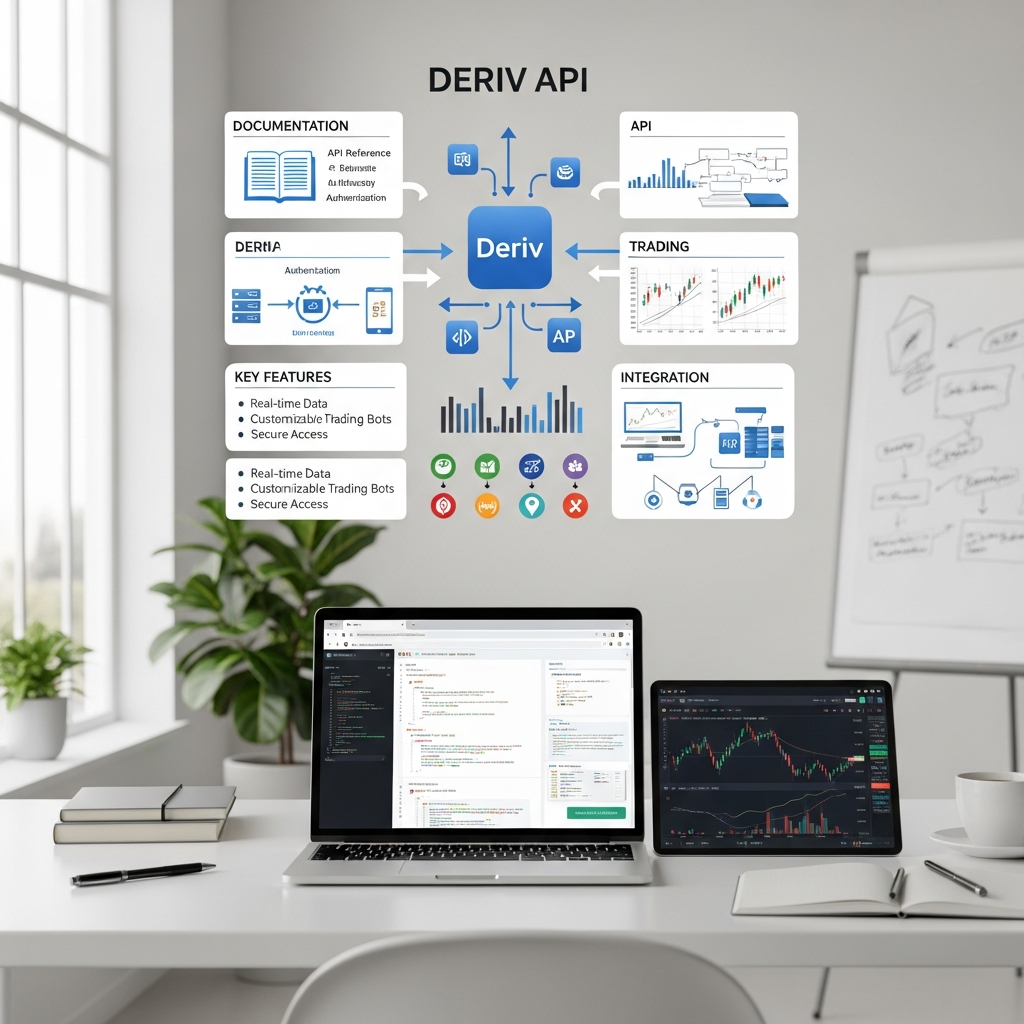
Initial Setup: Registering Your Application
Before writing your first line of code, you must register your application within the Deriv ecosystem. This process generates an app_id, which is a unique identifier used to track requests and ensure security. By registering, you gain access to different permission scopes such as ‘read’ (for viewing account data), ‘trade’ (for executing orders), and ‘admin’ (for managing account settings).
To start, visit the Deriv Developer Portal. You will need to provide a name for your app and a redirect URL. Even if you are developing a local script, a placeholder URL is often required. Once you have your app_id, you can begin the authentication process using API tokens generated from your account dashboard.
Understanding the WebSocket Architecture
The Deriv API operates on a request-response cycle via a single WebSocket connection. Once the connection is established to wss://ws.binaryws.com/websockets/v3, you send JSON objects to request data or perform actions.
JSON-RPC Communication
A standard request includes a command and optional parameters. For example, to check the server time, you would send:
{ "time": 1 }
The server then responds with a JSON object containing the timestamp. This simplicity is consistent across all endpoints, from simple pings to complex multi-leg trade executions.
One of the most powerful features of the architecture is subscriptions. By adding a subscribe parameter to a request (like a ticks request), the server will keep the stream open and push updates to your client whenever the price changes.
Core API Functionalities
Market Data Streams
Real-time data is the heartbeat of any trading app. The Deriv API provides two main ways to consume market data: Ticks and Candles (OHLC). The ticks endpoint provides the latest price as it happens, while the ticks_history endpoint allows you to retrieve historical data for charting and backtesting.
Managing Trading Accounts
The API allows for seamless account management. Developers can fetch balance information using the balance call or retrieve a list of active accounts using account_list. This enables the creation of portfolio management tools that can monitor multiple accounts simultaneously.
Executing Trades (Buy/Sell)
The core of the Deriv API documentation covers the price_proposal and buy workflows. First, you request a proposal to get the current price and potential payout for a specific contract. If the terms are acceptable, you use the buy command with the proposal_id to execute the trade. This two-step process ensures that you are trading at the price you expect.

Handling API Limits and Rate Throttling
To maintain platform integrity, Deriv enforces rate limits. These limits are typically based on the number of requests per second (RPS). If you exceed these limits, the server will return an RateLimit error. High-frequency traders should implement a queuing system or a “leaky bucket” algorithm to manage outgoing requests and avoid being temporarily throttled.
It is also important to implement a heartbeat mechanism. If a WebSocket connection remains idle for too long, it may be dropped by intermediate network layers. Periodically sending a ping request ensures the connection stays active.
Security Best Practices for Trading Applications
Security is paramount when dealing with financial APIs. Developers should follow these industry standards:
- Never Hardcode Tokens: Use environment variables or secure vaults to store API tokens.
- Scope Limitation: Only generate tokens with the minimum permissions required for your app to function.
- Input Validation: Ensure all user-provided data is sanitized before being sent to the API to prevent injection attacks.
- Secure WebSockets: Always use the
wss://(Secure) protocol to encrypt data in transit.
Frequently Asked Questions (FAQ)
The Deriv API is a powerful set of development tools that allow developers to build their own trading applications, automate trading strategies, and access real-time market data from Deriv’s ecosystem using WebSockets and JSON.
Yes, the Deriv API is free to use for both personal and commercial application development. However, users must adhere to Deriv’s terms of service and rate limits to ensure platform stability.
To obtain an API token, log in to your Deriv account, navigate to the settings or ‘Manage API Tokens’ section, choose the required scopes (Read, Trade, Payments, etc.), and generate a new token.
Absolutely. The Deriv API is built primarily on the WebSocket protocol, which allows for low-latency, bi-directional communication, making it ideal for real-time price streaming and high-frequency trading.
Yes, the Deriv API is highly flexible and provides all the necessary endpoints for account management, market data, and order execution, enabling you to build a fully functional third-party trading interface.
Conclusion
The Deriv API documentation provides an exhaustive roadmap for developers aiming to innovate in the trading space. By mastering the WebSocket protocol, understanding the JSON-RPC request structure, and implementing rigorous security measures, you can build high-performance trading tools that rival institutional-grade software. As you scale, remember to consult the official documentation regularly for updates on new endpoints and protocol changes. The journey from a simple script to a full-scale trading platform begins with these fundamental API calls.